9.11.09

The Oldest God in the World


Upon this
the oldest God and the youngest God concur:
The world is a bridge
Cross it but build no house upon it
The world endures for but an hour
Spend it in devotion
The rest is unseen


The Oldest God in the World [#51]
2009 Fammerée


Thank you, Michael Wood & Yehoshua ben Yosef


* * * * *

Richard Fammerée
fammeree.com
fammeree@att.net
director@universeofpoetry.org


* * * * *

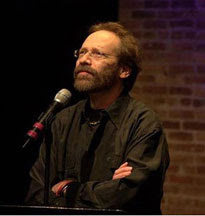
Photograph by Susan Aurinko

* * * * *

4.11.09

An English November


I stood here beside
this red post
this dog post
I stood here because
I did not want to see the way
the pastor the mirror the four
bevelled corners had used words
however accurate however bronze and fragrant
and I said faint
as in fabled
and you said sullen
as in silken
the way silk falls somewhere in this tented street
this lane again obscured
by moonlight more
vaporous langorous less
suspicious less deliberate than each humming
lamp
cold milk turning
cold each of us humming
fraying mumming I could have told you
but the progression to prayer was not
what you wanted to hear not that night
before the fire
in the grating in the pub the grazing
the green
viridian and oaken walls and glasses glowing
golden within
and without as if time were caught
in the sap of Hennessy slowing
to the tempo of the chair
in the door frame hovering unpainted guarding us from the future
glass within glass within glass
each of us stepping back
to that moment each of us silvery
curtains of filagree
and trees each tree
bowing never failing
whipped by wet wind still
dripping never ending enduring never
lime brushes turning black turning back turning
godly lit into a gilt Constable sky
a telephone a telephone a telephone
burrowing into absence
absence into absence into milky abstinence
quiet into rain into rain
lingering on the other side
of The Four Quartets 17 c.
quadrants of glass sky tree facade reflection
through a glass and a glass darkly she of he of she who had
occupied the sculpted chair the dead chair guarding us from the future
hovering in the door frame
you want me to return why now
sleep lay between us
your blouse
your brown shoes
your Run Lola Run shoes and the mystics
we imagined
into each successive light
only to enter the shadows of one


An English November [#50]
© 2009 Fammerée


* * * * *

Richard Fammerée
fammeree.com
fammeree@att.net
director@universeofpoetry.org


* * * * *

Photograph by Fammerée

* * * * *

17.10.09

Orpheus Recusant


In this widowed room I repeat
the lessons of my senescent heart,

bead by bead. I ready myself
for the opening of the bitter book

which counsels your faith
and the colored book attending

with cap and bells the approach
of our impatient story:

Attic blessed, fluted
with Lydian melancholies, the umbria
implicit in your breast

We adorn ourselves with tears and amethyst
as children of the Queen

No eclipse will ever elicit a denial
between us


This hand-pressed netting,
this veil of brides, this storied fabric winding
its whisperings about us, sleeplessly

compelling our mouths together for breath, for
birth:

I now assume Botticelli’s love
for you


And if time were to abandon us in some unmeasured
embrace, I would rest beside you
until we were chosen to be brought forth again
from the cold.


Orpheus Recusant [#49]
© 2000 Fammerée


* * * * *

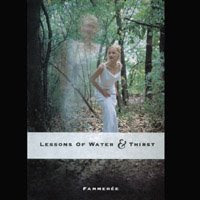
“Orpheus Recusant” appears in Lessons of Water & Thirst,
a book of poems by Richard Fammerée.

* * * * *

Richard Fammerée
fammeree.com
fammeree@att.net
director@universeofpoetry.org


* * * * *

Photograph by Susan Aurinko

* * * * *

11.10.09

The Absolute of Indigo

This mosaic of mesmerized silver
fish and chartreuse
scum harboring
seed pods
sailed all green things once
to the young peninsulas

of my lungs.

I was held to this stone
hundreds of fish years ago.
My mother warmed me and warned me; but
an emerald billowed up and
I skipped ahead, popping and twinkling
as a skiff's pennant, a tin of spinach
pressed to my biceps, and I begged my mom

not to be afraid.

All things are arranged now in my vessel.
I hear her. She whispers, Do not worry, as she passes,
bludgeoned
with twilight, into the absolute
of indigo.


The Absolute of Indigo [#48]
© 2000 Fammerée


* * * * *

“The Absolute of Indigo” appears in Lessons of Water & Thirst,
a book of poems by Richard Fammerée.

* * * * *

Richard Fammerée
fammeree.com
fammeree@att.net
director@universeofpoetry.org


* * * * *

12.7.09

Ephemerae

I could not sleep while you slept.
Any little animal might have sheltered
in your body; and I kept
leaves from your eyes and things from your hair
until your lips revived, bending
back my fingers to the lessons
of water and thirst. Fires that night
digested the wet, and when their long viridian
became your arms and a delirium
became our legs, threads
relinquished us, and we were not puppeted
by earth, and we were not puppeted
by heaven. We became
larger than form and texture and scent--
something like clouds--and fear was driven
from the manger of our bellies, and anger's thin
lips could not diminish us. We ate everything
that was red,
and everything red
was delicious. My sap was greening
your milky body, then your legs slapped.
They slapped into fins and you arced
and my chin and
ear separated, and silver and more silver and silver
again, I quivered behind you.


Ephemerae [#47]
© 2000 Fammerée


* * * * *

“Ephemerae” appears in Lessons of Water & Thirst,
a book of poems by Richard Fammerée.

* * * * *

Richard Fammerée
fammeree.com
fammeree@att.net
director@universeofpoetry.org


* * * * *

Ephémères (Français)

Je ne pouvais pas dormir pendant que tu dormais.
N'importe quel petit animal avait pu se réfugier
dans ton corps; et j'enlevais
des feuilles de tes yeux et des petites choses
de tes cheveux
quand tes lèvres se ranimèrent et revinrent
à mes doigts aux leçons
de l'eau et de la soif. Les feux cette nuit-là
digérèrent l'humidité et quand leurs longs viridiens
devinrent tes bras et le délire
nos jambes, les fils
nous lâchèrent et nous n'étions plus pantinisés
par la terre et nous n'étions plus pantinisés
par le ciel. Nous devînmes
plus grands que la forme, la texture et l'odeur--
quelquechose comme des nuages--et la peur était chassée
de la crêche de notre ventre, et les lèvres pincées
de la colère ne pouvait nous entamer.
Nous avons mangé tout
ce qui était rouge,
et tout ce qui était rouge
était délicieux. Ma sève verdissait
ton corps laiteux, puis tes jambes claquèrent.
Elles claquèrent en nageoires. Tu te cambras,
mon menton et
mon oreille se détachaient, et le vermeil et plus
de vermeil et le vermeil encore, je tremblais
derrière toi.


Ephémères [#47]
© 2000 Fammerée


* * * * *

Richard Fammerée
fammeree.com
fammeree@att.net
director@universeofpoetry.org


* * * * *

4.7.09

Sang-froid (Living With An Actress)


You touch as if to remove lipstick.

There is every shade of blond in the lock
stopped by the authority of your right
eyebrow. Editing annoys you.

Green bees upon a field of chartreuse annoy
you. Conflict between fabric and design
is unpardonable. (Napoleon and Madame R.
may have favored the symbol, but all this
belongs to a previous denouement.) After
your mother died, you did not come
home.

Last night you did not come home. When you
were Ophelia, I untangled each blossom
from your hair.


I fought past Hamlet into the grave.
I expired before you upon our tomb, assuming you
would follow.


You unloose your hair and the chimera
of a smile; I choose the long face
of a Sadducee, for in this next scene we deny
the resurrection of the dead


Sang-froid (Living With An Actress) [#46]
© 2004 Fammerée


* * * * *

Richard Fammerée
fammeree.com
fammeree@att.net
director@universeofpoetry.org


* * * * *

Photograph by Susan Aurinko

* * * * *

3.7.09

My Last Hour (Upon Paros)


Shakespeare would have introduced me
earlier, roaring forward into a high halo
of reflected light, bursting into
constellations upon the tomb of that Capulet
wall.

My heart is not ready
to be unhorsed; my horse is not ready
to be lead from unwashed dancing. What god
can offer a dispensation?


From a cold throne of seven marble steps,
I regard blades of hair and slopes
of shoulders, schooling forward in stripes
and prurient florals.
They are closer to the stem;
it is not this late for them.
The proud pennon of my smile flies before
the teeth of my defenses, but there is nothing more
and no one left to vanquish.
Archers and cupids relax their
wrists; and the statue of my head begins
to assume the face of a cloud.
I admit exhalations of every lung, leaf and
thing.

I breathe, I am, and I am
the sum. How I have occupied myself

with disappointments and intrigues,
amassing a coat
of many things and thorns.

I remove my shoes.
The vast ultramarine (for air is a sea
where we, the anxious, feed at the bottom)
claims the blue veins

of my feet. Ants crawl darkly in farewell.

They were first to play with me, too.
I remember.
I destroyed many with my heel and toe, grinding
them into pepper.

Why would a child do that? What did I know?
What did I remember?


My Last Hour (Upon Paros) [#45]
© 2009 Fammerée


* * * * *

Richard Fammerée
fammeree@att.net
director@universeofpoetry.org

* * * * *

Photograph by Susan Aurinko

* * * * *

2.7.09

An Argument for Eternity


A boy is holding a green button
A field is holding the boy
and three horses gazing and one
pony tittuping narrowly, narrowly, wanly
warily
. The river Egress
is holding the field and a fish
for every tree, a leaf
for every fin

Fire holds the river; sky holds the fire

The button is all that remains
of a velvet Sunday
school dress, green as everything forever
of the earth, forgotten of the earth, forsaken
in the earth, each wish, each
petal

All that remains of the girl, first
girl and last: rain and cathedrals
indistinguishable;
inviolate, the light regardless and green
recumbent

The button is holding the boy, green
boy, tree boy, ignorant of Sundays and Sunday
schools, their god, their heaven, their claims
to April
He seeks one promise as they seek one God

and he is guardian of the button, hand-painted relic,
splinter of her sixth year, pilule, proof of
resurrection, the second emerald
extant

the promise of her
chalice above and below


An Argument for Eternity [#44]
© 2009 Fammerée


* * * * *

Richard Fammerée
fammeree@att.net
director@universeofpoetry.org

* * * * *

Photograph by Susan Aurinko

* * * * *

1.7.09

Green Man (A Song)


If we were one God, we would feed each other
everything; and everything would eat us,
and we would never die.

My tongues would serpent in your temple
where water becomes blood;
and the pink imprint of our lips would be
a talisman above the bed.
We would not need
to protect our skin from light; we would not need
to protect our skin from skin;
and nothing red would be unclean
at the mouth of the Tigris.

I know what the dark book teaches, but the garden is within us all.

I am a green man, and I am my messiah now.
I am not embarrassed, I am not alone, I am
not afraid.
I cannot lose anything, for nothing is mine.
And I will never be hungry, for everything is mine.
Where, then, is the throne of heaven.

If we were one God, we would not appease
fathers of don't.
We would kiss the tips of each other,
for lips are the spout of the fountain
and eyes, the light of the fountain.
Nipples are ready to blossom,
and a rose is a mouth of the mother.
I am a finger, and you are a finger.
Our hand is a leaf, our leaf, a wing,
and leaves and wings will cathedral us again.


Green Man [#43]
© 2005 Fammerée


* * * * *

Richard Fammerée
fammeree@att.net
director@universeofpoetry.org


* * * * *

“Green Man” appears on Lessons of Water & Thirst,
a recording of poems and poem songs by Richard Fammerée.

* * * * *

Photograph by Susan Aurinko

* * * * *

A Boat


Your toes to my bow, a knee
to your aft, my fingers inside a strap of
your camisole, your arms vining
and rubbing
and the movement of my right shoulder

I untie from my God and every god story-- Come the wind
and the wake and the rain


Sap fattens and ovals our lips, blind
petals of a previous crossing
They are tart; they are wet
They are plum; they are asps


Look, the water is tarnished. It is the first generation
of leaves dying

Down in our belly
we are happy. We twine in the delicious
deciduous mess of our
pulp


A Boat [#42]
© 2000 Fammerée


* * * * *

Richard Fammerée
fammeree.com
fammeree@att.net
director@universeofpoetry.org


* * * * *

“A Boat” appears in Lessons of Water & Thirst,
a book of poems by Richard Fammerée.

* * * * *

Photograph by the artist

* * * * *

19.6.09

Notre-Dame (de Longueville)


A dead man bolted to a daed tree is
lodged like a bone in the throat of Notre Dame.

A tongue flickering in a lamp cannot be suppressed.

Before the burinings and conversions this choir
was a barrow where my fathes and mothers were brought
and planted like seeds in a belly.

The clerestory and blindstory were trees and each cold
intricacy, a leaf.

I forgive the bowed and kneeling patriarchs
and matriarchs separatee d by stone ribs, for they knew not
what they did or they were afraid or they did
know and are buried now in stone.

Before I left Chicago, I saw Auntie Jeanne standing
on the the corner of Irving Park and Clarendon.
A squealing bus did not disrturb her because she is dead.
Her coat was so old and her hat so ridiculous, I almost
hurried out to huddle her into my car,
but she wasn’t
watching for me, and she wasn’t
waiting for the bus like the others. She had come for her
daughter who was dying.

I have crouched in a savory cathedral like this before waiting
to be born, sipping and sleeping to the thumping
of a big bell beneath the bold
cupolas of a mother’s breasts, absorbing pink stories
from windows of flesh stretched
between ribs, woring
toward a slit at the nape of the twin towers
of her knees.


Notre-Dame (de Longueville) [#41]
© 2000 Fammerée


* * * * *

Richard Fammerée
fammeree@att.net
director@universeofpoetry.org


* * * * *

Photograph by Susan Aurinko

* * * * *

“Notre-Dame (de Longueville)” appears in Lessons of Water & Thirst,
a book of poems by Richard Fammerée.

* * * * *

18.6.09

A Rose and Its Seiche


When Daphne decided to allow her breasts
to receive mouthings, the severed Gods became alert, for her
essence could weep to the turnings
of a tongue.

Undefiled and clever, she wrapped herself
in incantations: a ruse and its worm, a rose and its seiche.

Now a deer, now a thrush nosed the vulva of a knot, and she
rose before him, and the moss of her unbound the blossom
of his lips.

Her chest became a harp and he became the other half.


Silver threads fastened their sternums, and she held his wrist
to her hip, and he rose into the god green ring.


A boar urinated down her untwining legs, tearing at new hair
indiscriminately.

Daphne tore at her hair.


There was coarseness and weeping aloud.
She concluded that speed and departure are preferable
to bark.


Once she stopped. Her breasts stopped. The wings of her hair
fell. Her mother (who had offered her plumper body
at the time of the boar) perched,

the size and color of a heart.


Beyond the tips of Daphne’s pinkness, a freckled back
strathspeyed, sprang, cartwheeled, reeled
and dashed, flipped,


flipped, flipped and leapt.

The thought--This could be my daughter. She should have been
my daughter--
frayed her lips.


A Rose and Its Seiche [#40]
© 2000 Fammerée


* * * * *

Richard Fammerée
fammeree@att.net
director@universeofpoetry.org


* * * * *

Photograph by Susan Aurinko

* * * * *

“A Rose and Its Seiche” appears in Lessons of Water & Thirst,
a book of poems by Richard Fammerée.

* * * * *

9.6.09

Asleep in Ireland

My forehead touches folds and stone. It is mud
and gold. It is sky
silvered. Its curls fondle a puddle where fingers abandon
the wind to huddle as babies
at my breast.

I am asleep in a waving field in Sligo, and the earth
mothers me.

Oh, how I love my sleep in Ireland.

All that has transpired during the previous nine years
is now a dream. When I awake
to myself unblemished,
dressed again in juniper:
I did not invite Deborah to Dublin.
We were not married in the Shelbourne Hotel.
We did not abandon the family on Wicklow,
and the family in Wicklow did not abandon me.
I did not retreat with her to Germany.
There was no divorce one year later.
I did not soil my story, and my story did not soil me.
I did not lose my adventure.


I first knelt in this dimple of nettles and puddles upon
the forty-second day of my great pilgrimage.
The sun was my shield, the fields unlettered and not dying.
I lay my bag next to this rock and lay my head
upon my bag.

I slept to the rhythm of cows
and clouds, the moon, invisible in cerulean, wandering
and blessing the shore of me
asleep upon this belly, burning with the yolks of furze
flowering into the big, dreamy, beating silence
of the embryo.

Hobo licks my palm. We walk hills wet, wax
green and valleys wetter and greener.
The sheep farmers do not concern him.
They have not yet poisoned him. He is turning away and
turning back, orange and lime
in the sun.

He is an Alsatian like me and a stray. When he died, I
buttoned him into my flannel shirt and buried him beneath
a plum tree.

We sleep now in Ireland, separated only by a vast mirror
of earth. I bite
into fruit nourished by his body. Hobo knows me
as I enter the mulberry trees.
My mother greets us from an iron chair. She rises. She, too,
is smiling victoriously. She is lantern lit, beautiful again.
I knew that she could beat the cancer.
I knew that she was still alive. I say to her,
Now, don’t upset. But there was a time I didn't know
you. Years and years when you wore your hair like this--
[I gesture.]
All lost. All that time is lost.
She begins to cry, but we are together again.
Before I can introduce Hobo, I awake.

I begin to move my limbs.
There is gray in my beard but I do not see it, for I have no mirror. I believe that I am healed.


I believe that I am healed.

All that I have dreamed is real. All that has shortened
my breath and scarred me is a dream.

With what god do I negotiate the is arrangement?
And what more must I offer?


Asleep in Ireland [#39]
© 2000 Fammerée


* * * * *

Richard Fammerée
fammeree@att.net
director@universeofpoetry.org


* * * * *

“Asleep in Ireland” appears in Lessons of Water & Thirst,
a book of poems by Richard Fammerée.

* * * * *

5.6.09

Orpheus Recusant

In this widowed room I repeat
the lessons of my senescent heart,

bead by bead. I ready myself
for the opening of the bitter book

which counsels your faith
and the colored book attending

with cap and bells the approach
of our impatient story:

Attic blessed, fluted
with Lydian melancholies, the umbria
implicit in our breast

We adorn ourselves with tears and amethyst
as children of the Queen

No eclipse will ever elicit a denial
between us


This hand-pressed netting,
this veil of brides, this storied fabric winding
its whisperings about us, sleeplessly

compelling our mouths together for breath, for
birth:

I now assume Botticelli’s love
for you


And if time were to abandon us in some unmeasured
embrace, I would rest bedside you
until we were chosen to be brought forth again
from the cold.


Orpheus Recusant [#38]
© 2000 Fammerée


* * * * *

Richard Fammerée
fammeree@att.net
director@universeofpoetry.org


* * * * *

“Orpheus Recusant” appears in Lessons of Water & Thirst,
a book of poems by Richard Fammerée.

* * * * *

4.6.09

L’Embarquement pour l’Ile de Cythère


We loved in the cup of a blossom
It was violet, it was Tuesday
petal deaf, petal deep
tintinnabulum
blue matinal sheer silent shivering

time, hand-sewn as summer, little seams, little scars

the past which always follows the bitter
chocolate, the particular wine

Wednesday, its gilded frame opposing the deep wooden bed, the shroud our bodies

blind scrolls

hundreds of mothers and fathers
before literacy, the touch of a blond beak to the palm, each palm

pressing back, it was this
juice rising and quivering in the wand of beginning and end

Beginning and end always with us

always
in that cup unitil it dropped its great violet, violent
head


L’Embarquement pour l’Ile de Cythère [#37]
© 2009 Fammerée


* * * * *

Richard Fammerée
fammeree@att.net
director@universeofpoetry.org


* * * * *

Photograph by Susan Aurinko

* * * * *

21.5.09

The Child Messiah

In a diaspora a bride is kneeling. Red needled
Rhine roses, white flowering, and rowan
embower her, worming

methodically, Gothically. Butter-colored
berries penciled in viridian wreathe her
hair, coiled to the hollow
of an immaculate breast. Within
that maw of two, unfinished
hands, a messiah begins.

His back is spotted with gold,
his fingers are filigree born from her body,
his lips love the timbre of her
nipples, and his belly is full of her.


One wind-reduced tree appeals the windless face
of the bald blue Father and his bearding
Son, swathed in crinoline

and icing winged. She molds the boy
beneath this tree.


Now the woman rises slender backed and silver
chested. She faces her discontent,
and Canaan becomes
dust.
The child faces the water.
The other shore, she assures him, will be
the same: the same white
grass, the same wild rowan and glass blue
sky, leaves sanctuary clean and gray, green
as dull, blunted blades.
Look-- There are no shadows
on the river, no serrated fingers
where blue fish feed.
But I am free, he coils.
I am twenty-four and I am free.
I could go anywhere from her
e,

his wrist flies and
flails. Dust-colored
magi smile, sucking
marrow and bits of roasted skin
from wings. Reliquary
wrist
, the lampblack decree.


One woman of successive faces
appeals this bearded son.

Each holds the boy beneath her
tree.
He must birth pomegranates and violets and
all things green and unraveling.
He must abandon his granite
patrimony and attend her
shadows with the unfailing
furrows and arrows of a father.
And there will be nights he must
attend alone;

but his lips love the timbre of her nipples as her hair
plays upon the sky a promise
of wings.


The Child Messiah [#36]
© 2009 Fammerée


* * * * *

Richard Fammerée
fammeree@att.net
director@universeofpoetry.org


* * * * *

12.5.09

Each Body Beautiful


Always ready to be unloosed from satin and the white bodice of clouds,
each body beautiful, its river, its sinuous logic,
its deliberate destination

towards the sun, away from exhausted deities, away from death

There I am before death and here after
the hesitation
between leaves, between
knees


The sky is worn thin, I planned to sing


[chorus, when sung]
Twelve thousand skies
Twelve thousand nights
I should have known
I would outgrow a fascination with empty


Each Body Beautiful [#35]
© 2009 Fammerée


* * * * *

Richard Fammerée
fammeree@att.net
director@universeofpoetry.org


* * * * *

Photograph by Susan Aurinko

* * * * *

11.5.09

Scar (Just Another Scar on the Body)


But sleep, a beaded talisman. Our hearts working
as rain, fluttering

forests of rose and bone, perpetually reborn, protected
by thorns, where fear is sin

where no sword turns

where angels are the body within

each body a portal

Each window as hesitation
What are salt and glass to me


You understand even if you pretend not to
The way the dying light favored you five hours later--
staining your blouse, staining our fingers

that last light lives in your body
and the soul of your body as auric deities hidden in dripping
caves


[chorus, when sung]
Just another scar on the body
Every arrow points to somewhere
You are always pointing to come home


Just Another Scar on the Body [#34]
© 2009 Fammerée


* * * * *

Richard Fammerée
fammeree@att.net
director@universeofpoetry.org


* * * * *

Photograph by Susan Aurinko

* * * * *

5.5.09

La fille de l'eau


La fille de l'eau, your petals
are palest.
Here you are a chalice
and here a narrow
sarcophagus diligently
cut and dressed
in frost, vested in
silk, pampered and pinned.

For the few months I was Vermeer, your profile confused
even the contentious God.

You wore orchids and chamomile. You chose afternoons. Your tears
found the font of my pillow.

After I wept at your knees, your taste was furtive and alluvial
as rain. Rain nourishes everything but history.

This is our secret, and the secret of trees.

Your poetess is Ophelia and your eyelids, her relic.

Le vent est de nouveau dans les arbres, et tu est inviolable.


La fille de l'eau [#33]
© 2009 Fammerée


* * * * *

Richard Fammerée
fammeree@att.net
director@universeofpoetry.org


* * * * *

Photograph by Susan Aurinko

* * * * *

29.3.09

Immaculate

Indiana? It all sounds decidedly Veni, vidi, vici. Separate the n from the D. More mythic, more appropriate. Clandestine and celestial. Just a suggestion. You’re the poet. I’m prepared to offer a short term solution. I’m being sent to the Holy Land (see glossy side of card) to resurrect the life of Christ. It’s ages since our adventures last year in Byzantium. I’ll arrange particulars, Skoog


1


Hysterical sopranos largely mother
frenetic, sloe-eyed, foal-eyed Samaritans;
a Via Dolorosa of cold
noses and dirty toes. A sheep has been severed
in a shed, running
red. Rose and periwinkle
wedding dresses sway their virginity above
me, wide eyed as corbels.

Where the hell is Skoog?

Here is blood pushing at dust and dust resisting as in
the first days of the first chapter. Our Father who art in this if anything, I am thousands of generations later, blood insisting within its vessel of dust.

Trumpet forth coarse beards if you must, but listen to these ancestors of our ancestors who never spin or sew. They are listed explicitly in a previous Genesis, descendants of dust and water and one of you but not a Jew, one of them but not Moslem, translucent in sunlight but not Christian. Here, they have witnessed an epiphany, the blind unbound and the blind offering sanctified blood [dam] to dust and the earth [adamah] made red [adumah] as a pin cushion.

Within an arch of fire and teal, a shaved mendicant stabs at my food. He is sick. I eat because I have paid for the meal, and I imagine myself with his illness. I wish that he had already died.

A green-eyed boy reveals red teeth, chipped as cheap trinkets. He wants more red soda. “I ask only five American dollars for any of these. You choose--” His teeth and gums are one color.

History is written in his febrile eyes and roan hair. Fourteen generations before and fourteen generations before that, a woman was impregnated by a shining man, stinking of leather and rust, grunting as a cold angel.

The boy is impatient. I become more patient. Why not-- My shoes have already been soiled with the blood of his father’s sheep and my meal has been spoiled.

I give him a dollar. He pushes it to my chest. “You could not ride on a bus in America with this.”

I push the dollar back.

He throws it at me. I drop the torqued bracelet onto his tea tray. It clatters without conviction. It has been handled before.

I place the dollar among his trinkets. He spits.

I follow him. This is, after all, the Holy City.

Smirking, smoking beneath the second station of the cross, his brother knows me.

“One dollar. Very clever. Perhaps, you are a Jew. No? You are Arabic, I think.”

“American.”

“OK, OK, Moroccan.” They laugh.

I laugh, revenant that I am.


2


Skoog and our new companions are more interested in Bethany than bracelets. Still, I bring them to the shop the following morning. In the chill of confusion beneath glass, I am offered the assurance that there will be no haggling.

Dieter toes the earthen floor with an impatience bred of impatience and racial superiority to dust and all things born of dust.

I choose a serpentine bracelet which fastens into a kiss, ringing Mylese’s wrist with its verdigris. A decade before in a Mediterranean village, I offered its twin to a woman I could have followed back to Aix-en-Provence (and may yet in a fictionalized account of my travels I am writing).

“Where is this from?” she murmurs.

“The desert.”

Heat and light break upon the window with the vengeance of Allah.

Mylese says, “It is very old.” Her fingers understand its value and function, but she and Dieter have decided that she is not allowing herself trinkets this holiday. They lift matching leather bags.

I return to the display case, crowded with old things and living things weaving webs. Mahmed and I separate remains of the dead.

“This.”

“That? Twenty dollars. Twenty dollars is too much?”

“No. Not if you say that is what it’s worth.”

“I didn’t say that. I said, ‘Twenty dollars.’ I said nothing about what it’s worth. What is it worth to you?”

I do not want my friends to surprise me in negotiations. “I’ll stop back later.”

“Later. Later it could be gone.”

“Later we could all be gone.”

He smiles the smile of his little brother and father’s father. “OK. Just take it. No, take it. It’s yours.” I fasten it about my left wrist. The serpents strain to kiss. “It is for a woman’s arm.”

She cannot fade, though thou hast not thy bliss, for ever wilt thou love, and she be fair--

“Eighteen dollars.”

“I’ll be back.”

“Where are you going? We made tea for you. For your friends, too. Tell them.”

“They’re not interested in tea. They’re waiting for me. And I don’t want to do this right now. I told you, just give me a price and I’ll pay it. No bargaining.”

“OK, I did this. Twenty dollars. ”

“Now, I can say, No, thank you. I don’t want this.

“But you do. I can see it in your eyes when you look at it. So, because I am your brother, for you I make it eighteen dollars. No, sixteen. Sixteen.”

Skoog and the Austrians, impatient as apostles, obstruct Lions’ Gate. A man, who has never shaved, wheels a cart of sesame encrusted bagels too close to Dieter. Dieter recoils. I purchase one for each of us. The vendor twists spices into Arabic newsprint.

“I like doughnuts,” Dieter confesses, examining it too closely.

Mahmed has followed from his shop. “Did you show them? Come back. Tomorrow. Bring your friends. You are all welcome.” He embraces me again. No one is particularly impressed.

We descend through a silence of scrub and stumble up the belly of an earlier temple.

“When the Messiah returns, he will emerge from the same gate.”

I turn as Lot’s wife. “I thought it was to be Golden Gate.”

“So did the Saracen when they sealed it. What did you pay?” Skoog navigates, calculates by the sun.

“Four dollars.”

“Pure profit. And you missed The Church of Our Lady
of the Spasm.”

Please--

“An Armenian treasure. Dieter had to see it.”

“Where?”

“Between Via Dolorosa and El Wad. Close to St. Stephen’s Gate.” Dust billows up.


I am stung by a bee in the village of Bethany. Beneath a skirt of leaves Mylese places my finger in her mouth. The swelling bores Dieter. He reads aloud, Now, when Jesus was at Bethany in the house of Simon the leper, a woman came up to him with an alabaster flask of very expensive ointment, and she poured it on his head, as he sat at the table. But when the disciples saw it, they were indignant, saying, ‘Why this waste?’

Anxious for tombs and ruins, Skoog negotiates with a man bent over a boy emerging nose first to unlock a dead bolt and illumine a naked bulb.

I enter the humid earth stupidly. I know this taste. It is the last and first, and the familial chill lures me to the place Martha and Mary’s brother was interred as a seed.

Of course, womb rhymes with tomb, and though the two words may be the shortest, most profound rhyming poem, I decide not to mention this to Skoog. He’d undoubtedly considerate it sophomoric, even if the Austrians might be impressed.

Dieter’s Bible exhales. Its breath is old as onions, cold as shoes.

“Is there enough light?” Mylese asks.

He is turning leaves, gold leafed, thin as days.

Translucent and plum-lipped, backlit, Mylese is projected to the shadows of my sanctum. Why here in the tomb of Lazarus?

Did you count the steps?

She offers her breasts in the cradle of her arms. She wants my eyes upon her eyes, their pale November, the vulnerability of twin gray creatures, the depths of a sea folding in upon itself, the sanctuary of her hair, its silk magnetized to my lip. Her fingertip traces a red cross stitched onto my tunic.

Rosary beads nestle upon her palm, not burning or burgundy as those dripping from my grandfather's translucent fingers the last time I saw him, but pearly as a virgin's first discovery. Each precious droplet of white and a cross tarnished as a conjurer's key, her voice thrills to my cheek, Shall I show you how to use these?--

They fall from her quivering.

My teeth wait whitely in utter darkness. An angel or marble angel, a Hermes, a pillar of salt, something white and substantial pressing against dust, Skoog. “I’m here.”

My hand is asleep, dead puppet. Look, I lift it with the other until the blood begins again and it feels. Mary, Mary, my feet feel the damp. He whom you love awaits the lost half of himself.


3


“No, it was you. You drove the Austrians away.” We recline beneath new leaves upon the same earth. “He was repeating a particular passage, and you fell asleep.”

July enters April everywhere. Their first born will dominate the sky and every chronology. Emerald is their urgency, the urgency of every union, a crown for a drifting poet who would bear a king, a circumference of jewels too numerous and ephemeral for collection or valuation. Why bother? Drift through, bless and be blessed.

“The light went out and there was suddenly silence, a Biblical silence, silence dripping silence, as in the first days--”

“Or the last.”

“Or the last. The only sound was your hibernation. I offered Dieter a torch, but he was dissatisfied. He entirely missed what he had come to find. Typical. Too prosaic. Too bad. He struck his head when he stood. It didn’t appear to have helped.”

“I dreamt of a woman in the tomb--”

“Ask if that surprises me. Nukhet?”

I close my eyes and focus my kingdom, a vernal luminosity violated by vermillion. There is no further retreat. Her legs tremble.

“Her mother had just returned from a pilgrimage to Lourdes with rosary beads. How could it have been Nukhet?”

“Do you remember the day her husband came looking for her--to our room? Where the hell were you hiding her?”

Skoog, there is an archeology greater than the sum of your fragments. Every story of a woman, her terrain, the trains of memory which bind her, the quiver and the hollow, the myths attending and the green chapel.

Tell her she had once reclined upon this marble bench; illuminate each page of her as Romans, as Phoenicians had, the breviary of her heart, her ringlets, vowels and anklets, portal and cupolas, the bell towers of her knees and altar of her hips, her eyes, her lips parting, the four directions of her crossing cushions of silk, the silk of her left and the silk of her right triumvirated by banners of random light and water light until only a stain of ochre remains.


“She hid herself.”

I reach for an errant root as I had once for her foot. Each knot intercepts streams of blood and sap as love does, as
we had. This is the way we are born and born repeatedly.

A stranger sketches Skoog sketching postures and orifices of a twining tree.

Each limb could be impregnated.

Unbuttoning, the stranger writes Apollo and Daphne at the top of his page. He shows it to me. I smile; he does not. I am distended in his sunglasses, a random temple of green faces.

Our new companion is interested in the antics of Jehovah and Odin. “My father was a Nazi, my mother, a Jewess, delivered from a sea of blood to an apartment in Haifa.”

“A Red Sea.” Mylese reappears wearing an intellectual’s narrow eyeglasses. “Clever. How is your finger?”

I offer it to her as a metaphysical curiosity.

Pieter continues with a story of a little boy hidden in a dog house, growing up with a puppy and learning that language before his own.

Every other word must satisfy me.

How can the sky appear so clean, so ultramarine and leafing green after all it has witnessed?

Pieter frowns delightedly. “You see-- I told you [me, Skoog]. It is always a contest between deities.” His fingers begin an immediate, bony retreat.

Dieter calibrates a silver device.

On Ben Yehuda Street survivors stare at the delighted German speakers. Exhaling flamboyantly, Pieter raises a tear
of flame to the pink knuckles of his other hand, “I embody--” sizzles the cigarette-- “that theological struggle--”

Mylese smiles to each of us, her hair one dark wing.

Dieter disturbs it back into black strands.

“Sh,” she motions with the wand of her finger.

Pieter is telling the story again of learning the puppy’s language before his own.

“Give us a sample.” Classic Skoog.

Mylese suspects that she, too, may be part Jewish--“on Opa’s side. I adore their kind of music.”

“And she plays it rather convincingly. On piano.”

“Probably,” Pieter concedes. “Why not!”

“I’ve had enough of these wankers,” Skoog extends a leg.

Dieter’s leg responds. “May I talk with you.”

“You,” Skoog nods to me.

“We’re leaving for Capernaum.”

“This only takes a little moment.”

“Please.” Skoog crosses his ankles. “We have a little moment. Several.”

A mother, two tables away, massages a lemon into each glass until its virginity has offered everything to water.

Dieter produces a postcard. It is a representation of a primitive canvas.

Skoog examines the image with trained compassion. “Your grandfather?”

“Joseph Smith.”

Mylese, born Mormon, lifts the card from my hands. Dieter, saved from a dissolute life by Mylese and her society
of Latter Day Saints, details the extraordinary exodus of a lost tribe of Israel deposited by a second great flood in upstate New York where they buried golden tablets of a new covenant to be discovered more than three thousand years later by Joseph Smith. He places the card back into my hands: “He is being informed by an angel as he sleeps.”

Informed by an angel as he sleeps.

“And where are these golden tablets now?”

“I suppose you’re asking as an archeologist?”

“I suppose.”

“Dieter.”

He pushes back at Mylese’s knee.

I divert him faithfully: “Allow me one question. If the answer is No, I convert to your faith.”

“Like an American Game show.” [British, astringent]

Ha ha ha. Ha ha.” [Australian]

“If the answer is Yes, you desist from proselytizing.”

Mylese makes a little sound. She kisses the hair above my ear. “Goodbye.”

Dieter says, “Yes. All right.”

“At any time during a day, a week, a month, a season, a year, a lifetime--according to your faith--are women considered unclean?”

Mylese kisses two fingers for a cigarette. Pieter reaches forward.

Dieter dips toward his black book. “Rejoice and be glad, for your reward is great in heaven, for so men persecuted the prophets who were before you.”

Let what you say be simply Yes or No; anything more than this comes from evil, I remember and regret not having answered.

Striking the street with sandaled feet dry as match heads, I flutter forward to myself, I am thirty-three and I am free. I could go anywhere from here. The trees ascend, their ascent implicit, fluttering.

“We must visit Frenchie,” Skoog decides.

Wise. The humid dark and our continuing adventures are so much more delicious from within her tinted widows. Periodicals, glossy as lipstick, air conditioned to the touch, comfort and discomfort me.

I find Anabasis with a foreword by TS Eliot among the bilingual books.

Skoog persuades her to close early.

“Prenez le livre.”

“You’ve earned it,” he confirms. “Be ready to leave after breakfast.”

This blind moment, of no particular significance at the time, attends my return as an idol set into a high place; but, of course, there is only an increasing distance, for I have returned and stood before my full reflection in the dark glass shadowing the place where the book in my hands had been found.

Everyone and everything familiar is gone.


4


Beside a pool in Cana, a girl interprets petals of a lily. Once considered, each floats to the center of a flame of reflected light, its genesis.

I sit so as not to disturb an epiphany.

The seiche of leaves suggests that a lifetime is a turning and a turning. An unnatural summer clings to her unwashed hair. The dream in the tomb propels me.

“We may be the last guests at the wedding.”

“I doubt that.”

“What do you doubt?”

“All of it.”

“What are two thousand years in the mind of a god?”

“You’re seeking a miracle.”

“Am I?”

“I’m not it.“

“No. I suppose I am. Is that the correct answer--”

“It wasn’t a wedding.”

“What do you mean?”

5000 guests? Have you ever been to a wedding with 500 guests? What does that sound like to you? Water into wine, wine into blood-- If there was a sacrament, it was between a savior and a desperate people. Remember, all of this took place during an oppression by one of the most powerful, brutal empires in history--at least until now. Read it radically--”

“Metaphorically.”

“As the Bible was meant to be read.”

“As poetry. Skoog.”

“Sally.”

“Delighted. Speaking of poetics, polemics and Romans, we’re off tomorrow for a mountain fortress at the Dead Sea. Interested?”

“Masada?”

“Precisely. “

“I’ve been.”

“Not with us.”

“I’ve just arrived here.”

“So have we.”

“What’s the hurry, then?”

“We’re on the lamb. A posse comitatus of Mormons is only a day behind. And they’re ardent.”


I wanted to address an apparent confusion between Cana and Capernaum, but the sky was changing.

We descended to the Galilee, kicking dust.

The student who booked us into the hospice without interest, without conversation, served our dinner on a stone patio overlooking the strand where Jesus had ministered to day laborers, mercenaries, thieves and prostitutes according to scriptures--and to his wife according to scriptures suppressed according to Sally.

Our camaraderie multiplied, and we hurried behind our shadows to the sea. The water deepened into an irrepressible womb, prophecies rushing our feet and disappearing as quickly. Skoog instinctively began to collect driftwood. Sally offered her blond body to the lapping.

The hostess brought Sabbath wine to our symposium, a chorus of flames dancing the great apricot death of the sun between us.


“My name is Shoshana.”

She wore a pinafore and no shoes, and struggled to run with our conversation. Sally and Skoog, English and increasingly inebriated, spoke rapidly. I compensated.

Soon, there were two couples in separate conversations, and the water rising.

“My name in English, someone here told me it is Lily.”

I imagined all the Sea of Galilee has witnessed and all that could have been, all the beauty that was and is
lost irrevocably, mirrored back in this dark Deuteronomy, unremitting, shimmering with the faint spark of marble, whispering to any artist who might release and embody it. Shoshana exhaled, each syllable colored as beads in the markets of Jaffa Gate.

“I don’t speak Hebrew.”

“Perhaps you’ll begin to learn.” Her smile was impish, suggestive. “We should swim. It is a fine evening.”

Her dress puddled about her, each toe nail red as the surprise inside. A fine evening. Remnants of the British Empire, I smiled following her in, my teeth uncertain but ready.

“Have you seen much of my country?” Her voice, amplified upon undulations, was too close. How could anyone have walked upon this water. It was difficult to tread.

“Jerusalem. Bethany.”

“That’s the same.”

“The Sinai.”

“That is Egypt now. Did you climb Mt. Sinai from the monastery?”

“I did.”

“It is very dramatic, Santa Katerina. I did this with my school. Did they wake you in the dark?”

“Yes.”

“And they showed you the burning bush of Moshe?”

I nodded, I shivered.

“And you saw the sunrise from the teap?”

“The teap?”

She arranged her hands.

“The peak.”

“Is that what it’s called. Peak. Like peek-a-boo?”

“I suppose.”

“So you were there for the sunrise? It was a beautiful moment for me. My mother is not religious. She is Palestinian and her family has been here since the beginning. She says they were Jews before the Jews now--do you understand?--before Mohammed.

“There is something that has been passed from mother to mother since then. It is small with very, very small writing in it. I don’t know what it is called in English. It will be mine.

“My father was from Russia. He is angry anyway. Together they worship no God. No one. So, I didn’t know any words but I made them.”

“I did, as well. I recited a poem and asked that the desert swallow me if it displeased Jehovah.”

“A poem? You make poems? Perhaps, you will make a poem about this.” Her smile, most ancient vessel, floated toward me, and her breath was as pink.

“Say the poem you made for God.”

“You know the Lord’s Prayer--”

“I don’t know.”

Our Father Who art is heaven hallowed be Thy name--?”

“No. What is this from?”

“It’s a Christian prayer. Christ says it in the Gospel of Matthew. I wrote--or recalled--the lost half.”

There was only our breathing and dripping upon the face of the water. Half in, half out, we became progenitors of a slender new species.

Our Mother who art in everyone, everything is thy name. Thy garden serene, thy waters green the earth as they blue the heavens. Thank you for our daily bread and the blessing that no one can be satisfied until everyone is fed--


“I’ll show you someplace,” her hair darker than the obscurity, expanding somehow as an unidentifiable object
of childhood. We emerged at the gate of a fallen tree. “This was their camp, where they waited for him and he waited
for them.”

“He?”

“Yehoshua. The one you and your friends are searching for. Your prophet. ”

“How do you know?”

“We know. Maybe your friends would like to see this.”

Her hair hesitated. I hesitated. Her hands were upon the trunk. I was behind her. She had not removed her bra. It was wet. It was flowering. We dipped beneath the branch to a chapel of fitted rocks and willows. Her hair was a curtain to be parted. It was rope. I clutched at her, then I was the horse. She was atop me hurrying us into eternity.

She became a vessel and carried us even closer.

“With no witness other than the story written forever upon us.”

“Say it again.”

“Forever upon us,” passed as a wafer to her tongue. I confessed into the dark chapel of her. The water was swallowing. She reached for something, my shirt, to cover her face; but I heard her call. It was Hebrew, the language of the old faith seeded in this hollow where Shoshana was quivering, rooting as the last and first.

I pulled everything away, the shirt, the bra. She pulled me back and pulled me back until there was no further. The chalice emptied. The chalice filled.

We awoke at the same moment, my bones, her bones, the bones of the earth pressing. Shoshana kissed my face in four places and hurried away. I watched with the hunger of Solomon. I needed no scribe to help me compose a song of songs.

The water and I receded. Stones glistened, revealing a lineage of rubies. The water and sky prepared to birth light, and I decided to stay awake, for, after all, this was the sea of Galilee; and Shoshana would return. I kicked at a charred remainder of our fire, as if I could have dislodged it from my breast.

The sun began its auric ascent. The religion of night, its moon and attenuated light was again vanquished.

My swimming trunks secured to a branch remained the only testament of my visit.


5


“Swim in your underwear. The Russians do. The Dead Sea destroys everything anyway.” Skoog speaks through his reflection in a window of a bus roaring forward.

I see Shoshana rising from the water; her bra is folded in my pack. I anticipate each blossom. The song playing in
the bus is intimate and heroic, and she moves beneath me somewhere left of my heart, between two ribs.

Skoog turns to Sally to whisper but kisses her hair. Terraces of new forest circle the ancient heights of Jerusalem
as my beard had circled Shoshana’s aureoles in fitful revelations of moonlight. With each pilgrimage they inclined
to me as a silver dome and golden dome do now.


6


Sally and Skoog frolicked in the Dead Sea, avoiding the fierce strokes of light and back strokes of barrel chested men and women. I floated until I became nauseous and rinsed off in the springs of Ein Geddi as David had done before he was king. Sally wore Skoog’s T-shirt. My shoes, as prophesied, permanently discolored.

Skoog rose as a golem in last light. “Shakespeare, Sally and I have had a little tête-à-tête about you. Frankly, I’m concerned. You haven’t been much fun since your nap in the tomb of Lazarus.

“We’ve decided something criminal is called for. We’re climbing Masada at dusk.”

“Is that illegal?”

“Decidedly.”

The Dead Sea disregarded us scissoring the face of a Judaean mountain. The path Sally somehow reconnoitered in the night could never have supported a plague of soldiers, caparisoned and harnessed to a massacre. This must have been a ceremonial ascent to the original pleasure palace built for Herod. It was already a ruin when the last Jews to resist the Roman Empire, forty years after the death of Christ, chose this as their final station.

Just beyond the site of their communal suicide, there remains a fortified wall, and below, upon the floor of the desert, identifiable between the moon and camera obscura of cast shadows, the enemy camp.

“No. No sleep here.”

I turned from the spectre of a story larger than my own to a small man in an oversized uniform, not Roman, perhaps Romanian. He should have alarmed me, but he had not. I had anticipated something broken behind me.

I led him to Skoog. “Thou art a scholar; speak to it Horatio.”

The guard appeared delighted with our ruse, especially our Sally who stepped to a proscenium marked ceremonial bath and surveyed us and everything beyond us as the salt goddess who had waited and watched in that place, backlit by the same moonlight, long before Romans and Hebrews.


For more than an hour, there was no sound or movement aside from the slither of Sally’s sleeping bag.

My eyes were occupied with everything that had brought me to this promontory, when a sphinx leapt past as a gazelle. Skoog bruised my arm: “Metempsychosis.” He was redeemed. He could sleep now.

“We’re all ghosts anyway.”

His small laugh defied and defiled the emptiness.

“I slept with Shoshana. The woman from the hotel.”

“Ah.”

Sally lay immobile within her blue cocoon. I was sad and disoriented, for, suddenly, my cocoon was far away in the north, in the north of another woman’s body.

I had been enchanted with Sally, the delicacy of her hair, the pale light of her eyes and name amplified by the lily pool
in Cana. I had been a little in love with her, or, at least, the moment. That--and we--belonged to a previous age now.

“She covered her face.”

“With her hair.”

“With my shirt. I heard her through the shirt.”

“I suspected you were together. She took to you the moment we entered the hotel.”

“I hadn’t noticed.”

“She has a way to contact you?”

“Yes.”

“Yes. Of course. And do you have her telephone number?”

“I have the hotel’s.”

“What is her family name?--

"That’s what I feared. You realize you’ll probably never hear from her if she becomes pregnant.

Blessed art thou among women and blessed is the fruit of thy womb-- A stranger, perhaps an ascetic or a soldier, a prince, a poet. A poet.

“Cheer up. Sally and I have decided upon a flight into Egypt. Why not come with us at least as far as Mt. Sinai.
You seemed happy--at least, purposeful--even--heroic there.”

“I already have Jehovah’s opinion.”

“I suppose you do.”

There is a photograph of the three of us, disheveled, the sun rising as a fourth face behind us. It is a portrait of my youth captured in a place that was already old in the first pages of Genesis.

A second photograph arrived with the first snow. Shoshana is supporting herself against the gate of a fallen tree upon the shore of the Sea of Galilee. She is slightly out of focus which, against the sparkling water, gives the impression of a revenant.

A note says something about having fulfilled a promise, but it is difficult to decipher. I carried it to the single, surviving rose in the walled garden and almost believed that the vindictive acceleration of days was relaxed by evidence of communion. The tip of the letter touched a flayed lip. Sad, ugly rose, too red, too large for its stalk.

I drank from its cup but could not forget.


7


I study the photograph and believe, or want to believe, that she is wearing the bracelet.

Occasionally, I imagine a telephone call from a teenager. I listen to him introduce himself. His name is short but unfamiliar and a little difficult initially. We speak of his mother and the last fifteen years, his first fifteen years. I have prepared words, but it is best to listen. After all, his father now would not be a stranger, a ghost, but a man of recognizable convictions, a worker on a Galilean kibbutz, a carpenter, for example.


Immaculate [#32]
© 2009 Fammerée


* * * * *

Richard Fammerée
fammeree@att.net
director@universeofpoetry.org


* * * * *

19.3.09

Notre-Dame


Our Mother who art in everyone,
everything is thy name.

Thy garden serene, thy waters green
the earth as they blue the heavens.

Thank you for our daily bread and the blessing
that no one can be satisfied until everyone is fed.

Forgive our ignorance as we forgive
those who ignore you in each of us.

Lead us from fear and deliver us from anger
and anxieties,

for life is a ripening to return to you, to feed you,
to seed you,

to be reborn forever and ever

Again


Notre-Dame [#31]
© 2004 Fammerée


* * * * *

To experience the live performance of "Notre-Dame
(Blue & Green)" with music composed by the artist,
please visit:
http://www.reverbnation.com/fammerée
and listen to selection #2.

A video interpretation of "Notre Dame," created by
the director of TWiN Poetry International, can be viewed
at: www.youtube.com/watch?v=rxckOMETDH0

* * * * *

Richard Fammerée
fammeree.com
fammeree@att.net
director@universeofpoetry.org


* * * * *

Photograph by Fammerée

* * * * *

Notre-Dame (Français)


Notre Mère qui est en nous
tout est ton nom.

Que ton jardin soit serein, que tes eaux
verdissent la terre comme elles bleuissent le ciel.

Merci pour notre pain quotidien et le bonheur
d'être certain qu'aucun ne sera rassasié
avant que chacun mange a sa faim.

Pardonne-nous notre ignorance
comme nous pardonnons
à ceux qui t'ignore en chacun d'entre nous.

Ne nous soumets pas à la peur mais délivre-nous
de notre colère et de nos tourments,

Car c'est a toi que revient la maturation
de la vie, pour te nourrir, t'ensemencer

et renaître pour les siècles des siècles

Encore


Notre-Dame [#31]
© 2004 Fammerée


* * * * *

To experience the live performance of "Notre-Dame
(Blue & Green)" with music composed by the artist,
please visit:
http://www.reverbnation.com/fammerée
and listen to selection #2.

A video interpretation of "Notre Dame," created by
the director of TWiN Poetry International, can be viewed
at: www.youtube.com/watch?v=rxckOMETDH0

* * * * *

Richard Fammerée
fammeree.com
fammeree@att.net
director@universeofpoetry.org


* * * * *

Photograph by Fammerée

* * * * *

Notre-Dame (the story)


I have visited so many sacred sites, by design or fortune, that
a singular lesson has been amplified beyond revelation to certainty:
each of us is the innermost sanctum. One needs travel no further
than the soul to experience the most perfectly proportioned temple
and the most daringly elegant cathedral.

Still, I shall relate the story of "Notre Dame," a poem which has already
surpassed me and my relatively few years walking the earth.

Kato Zakros is the final town at the eastern tip of Crete, an island
of famous mythologies (Minos, the Minotaur, its labyrinth; Theseus,
Ariadne; Zeus, Demeter, Persephone, Dionysus (prototype for God
the Father, God the Holy Ghost, Mary and God the Son)) and mythic
civilizations (Minoan). I had once dreamed of living among its fabled
palm trees--the first I would have ever had seen--during my two year
journey (which I sometimes call my third crusade) which began in
County Kerry, Ireland, and ended in Jerusalem. Nine months into the
adventure, that first spring, I found a garden house in Mirtos (along
the southern coast of the island) and ventured no further east than
Irepetra.

I finally visited Kato Zakros fifteen years later during my return
pilgrimage to Mirtos. I found a small room above the pebbled beach
which looked directly across the eastern Mediterranian to Acre.

It was in that white bed floating over the site of a vanished, vanquished
Minoan Temple, the Queen’s Magaron, the wife of the Lord’s Prayer
appeared to me. It began as a trickle of words in the fissures of the
ancient, shadowy ceiling, and they puddled into a cloud settling
upon my chest and blossoming behind my eyes.

I rose and wrote out the Lord’s Prayer and began to construct a new
poem--its “lost half”--alongside.

Nine months later, I discovered the poem folded into Anabasis
(St. John Pearse) at the bottom of my knapsack among fragments
of writing and songs and addresses hurried across
half sheets and receipts. I left it in my bag as I prepared for a
flight to Tel Aviv.

I arrived to Jerusalem three weeks before Passover and Easter
and decided to begin my Peace Tour of Israel, Jordan and Egypt
immediately to arrive back to the Holy City during holy week.

Having crossed the Red Sea into the Egyptian Sinai after a fortnight
of wandering Arabia enroute from Jerash and Petra to Aqaba, I
settled thankfully into a straw hut in a Bedouin camp. A little shade
upon the path to Mt. Sinai was a relief. There was another westerner
living in the camp, a German woman whose intensely blond hair was
always covered with a black scarf. A devotee of mysticism and desert
deities, particularly fertility goddesses, this woman without child
kept to herself. One afternoon we met in the absolute silence of the
desert near a primitive sink. If I were composing a Bible story, I would
say that we met at a well.

I recited the fragments of the poem I would name "Notre Dame" two
weeks later in Cathedral of Notre Dame in Paris enroute back to the
States.

Her eyes were intense as the sky we were hiding from, her skin
cured as a person’s twice her age.

Hermitic--and hermetic--as she was, she encouraged me to birth
the words to the world; and I finished the poem that night walking
beside the gentle ripple of the Red Sea, revising aloud with each
step. It was a full moon, and I recited into its eyes and purity.
Distant fires in the desert, I later learned, were Israeli families
singing and feasting, for it was also the eve of Passover.

I recited Notre Dame into Mount Sinai. I said to Jehovah, “If this
poem displeases you, I stand here naked in the place where two
apostates (with rather complicated, forgettable names) were
devoured by the earth--”

The night remained still, benevolent.

I recited the poem again a few days later on Easter Sunday in Jerusalem
at Christ Church.

And again months later at the invitation of His Holiness the Dalai
Lama during the World Festival of Sacred Music. I had just returned
from the island of Kauai where the music had been born as Aphrodite
from the sea.

Melissa Dittmann, now living in the back country of Tibet, graciously
accompanied me. Fortunately, I recorded the moment.


Notre-Dame [#31]
© 2009 Fammerée


* * * * *

To experience the live performance of "Notre-Dame
(Blue & Green)" with music composed by the artist,
please visit:
http://www.reverbnation.com/fammerée
and listen to selection #2.

A video interpretation of "Notre Dame," created by
the director of TWiN Poetry International, can be viewed
at: www.youtube.com/watch?v=rxckOMETDH0

* * * * *

Richard Fammerée
fammeree@att.net
director@universeofpoetry.org


* * * * *

Photograph by Fammerée

* * * * *

26.2.09

Musée de nous


As cumuli, as snow impending, I begin
to arrange the Musée de nous: first names
and last; a pink gesture,
an epiphany and its shadow;
ten digits, two hyphens,
a hieroglyph
no longer; dried lilies
from the knoll, a twig bent back
at its tip; the first je t’aime hurried
onto the back of song lyrics and accurate
directions three hours before, an accumulation
of directions. Each kiss pooling in satin, salon
des baisers
, salon des baisers perdu, periwinkle,
for it was high summer, the deep hemisphere
of the Virgin’s cloak, the softest cerulean of
your blouse the evening we lay in the lawn
behind the field where students run, every
promise and rose deepening to must. We
integrate and disintegrate in a vintner’s box
two clasps thick, large enough for interring a
pet and purposely frail (as a body is frail and
porous), so that if we gift nothing more
in this lifetime or any other, the sensation of
lips opening and breath entering will
continue.


Musée de nous [#30]
© 2009 Fammerée


* * * * *

Richard Fammerée
fammeree.com
fammeree@att.net
director@universeofpoetry.org


* * * * *

Photograph by Susan Aurinko

* * * * *

La portail (de La Vierge de Paris) I


I stand in Notre Dame de Paris facing Jerusalem as I had when my soul was older and burgundy and clanked upon these stones. Within this portal, a girl lingered as the statue of a girl. Her hair is as it was then, a great living wing steadying for flight. And, though she would attend church with the children and sing piously and prettily, brittlely, our home and gardens of neat rows prophesying petite-fille champagne roses would always be her Bethlehem, Jerusalem and Gethsemane; while I, in the revenant dark, revisited the saintly, the devious and the dead, leaning again upon my sword before Damascus Gate in the sweet stench of first light.


La portail (de la Vierge) [#29]
© 2009 Fammerée


* * * * *

Richard Fammerée
fammeree@att.net
director@universeofpoetry.org


* * * * *

La portail (de La Vierge de Paris) II


Here is the great altar where six centuries later Pius XII anointed Napoleon on a cold, clear day, three weeks before Christmas, 1804. He became our emperor in the moment he crowned himself and his poplar wife Josephine. I watched from within this portal, pressed to a leather and studded oaken door before the great stench and exhalation of a populace grateful, after fifteen years of unpredictable brutality, to once again have a consecrated ruler. The cathedral had been scrubbed and dressed. Gone was the severity of a temple dedicated to the Cult of Reason and the Cult of Supreme Being, though statues of biblical kings remained headless.

I was cautiously optimistic. The empire was secure and expanding. I married Anne-Marie-Josephine, sister of my good friend [and great-great-great grandfather in this lifetime Jean-Joseph]. I admired the family. They were efficient and musical. Artistic and adventuresome. Their name was a marriage of two words: famille and mere. This could be translated as “family of the mother” or “family of the sea.” Or both. I certainly considered them a tribe, a Mediterranean and, lately, Norman tribe embraced by the sea. A brother had already left for Quebec to follow an uncle; others had been planning to settle in the wilderness of new France. This, of course, would be delayed since Napoleon, to finance his wars, had sold one third of the North American continent to President Jefferson the previous year. The Louisiana Purchase may be the most foolish real estate transaction in French history; it certainly changed our plans. Military initiatives failed, and we were subjected to two decades of misery and national embarrassment.

Half a century later, Jean-Baptiste, our nephew (Jean’s fourth son), allowed his mustache full sail, arrived finally to Ellis Island on the Gertrude, May 13, 1856, and continued west to homestead 40 acres deeded by President James Buchanan in the new state of Wisconsin. [His great-great-granddaughter Jeanne holds the deed and inhabits the wooden house built around the original cabin of hand hewn logs.]


Before my daeth, I returned to Notre Dame with my grandson who was chivalric and impertinent. [He actually reminded me of myself one century later; his sensitive soul bound to a societal disillusionment which wore the alternating masks of anger and cynicism.]
The cathedral had been restored--therefore, saved from destruction--by France’s celebrated architects Eugene Viollet-le-Duc and Jean-Baptiste-Antoine Lassus only to be violated again by a bonfire of chairs in its belly started by rabble of the communard. Philippe explained this to me jeeringly. It was an angry time. He despised the Prussians and distrusted our government. We all did.


Later, that summer, voracious fires crossed Green Bay, Wisconsin, destroying much of the Walloon community, and, further south, decimated a settlement barely thirty-five years old, named after the native word for swamp onion, Chicago. Progressively, Philippe left his circle of friends, including a Belgian poet and French poet (Verlaine, a second cousin) who were dangerously provocative, and followed sturdier cousins (stone masons and carvers of marble) to help rebuild the new world from ashes. His eldest cousin Jean-Joseph (second son of Jean-Joseph’s youngest son Constant and named for his father’s father) settled in Chicago. [His grandson would be named Richard as would be his son. I am that son.]


La portail (de la Vierge) [#29]
© 2009 Fammerée


* * * * *

Richard Fammerée
fammeree@att.net
director@universeofpoetry.org


* * * * *

25.2.09

La portail (de la Vierge) III


One deciduous April morning inclining bleakly back to February, Maurice de Sully, Bishop of Paris, evoked a vision of a celestial, Olympian cathedral from the damp, bald earth at our feet. For the next thirty-six years, until his death in 1196, he would devote his energy and fortune to this chef-d'œuvre. De Sully was correct, of course. The “parish church of the kings of Europe” must be “transcendante.”

And, so, we began to cut and finish stones. I watched the rough men heave and cart off the original Romanesque church, the Cathedral of St. Etienne founded by Childebert in 528 upon the foundations of a Roman temple to Jupiter. Suddenly, all that had been consecrated was no longer sacred. An eternal lamp became an oddly decorated lantern whose flickering tongue was cold behind a curtain of somber, once sanguine glass.


We had prayed in that church for generations. I had been baptized in the shell of its font as had my wife and our sons and daughters. The old, leaning houses sharing the church wall were removed to create la rue Neuve-Notre-Dame, a road for immediate supplies and later processions. An auberge of great planks had belonged to the parents of my grandfather; distant cousins were peremptorily removed.

I helped clear the ground, passively, stoically.


I may be the last person to have seen the holy well--the spring, la source where earliest inhabitants of this eyelet, this steady barque of land (Fluctuat nec mergitur), this Île de la Cité, worshipped the font of life and its Gardienne--before it was sealed with a great stone, marked with a fish (an alpha), omega and a second alpha (an eye).


And upon that seal was laid the foundation stone blessed with appropriate pomp and promise by Pope Alexander III. I vowed never to forget the sight and taste of the water, and this preoccupation has passed through many intervening centuries.

Behind the altar there is a false tomb
and beneath a Christian name there are thousands
of years of roots writing through stone
and water echoes up vertebrae
which must have been steps
and its light is the juice of emeralds


La portail (de la Vierge) [#29]
© 2009 Fammerée


* * * * *

Richard Fammerée
fammeree@att.net
director@universeofpoetry.org


* * * * *

21.2.09

La portail (de la Vierge) IV


No one among us believed in a Father alone for protection or salvation, certainly not a son. We knew our sons too well. We had watched them hurry off to war for adventure. We watched another generation follow Heraclius of Caeserea from the skeleton of the new cathedral in the first promise of 1185 into the maw of a third Crusade.

We knew and understood the secret that would elude archbishhops, bishops and priests for centuries:

Notre Dame de Paris is a woman.

She does not hesitate upon her back, her knees towers, arms open to each side, each palm a chapel. She awaits the seed of heaven; we kneel and rise within, stained and cleansed by light shining through each roseate window stretched across a mother’s ribs. Each cathedral is woman and forest, often constructed over a sacred grove and spring. And from the flickering heart above the altar to the floral intricacies of the door of her womb, the faithful emerge, each born back into the great, deep world.

I have crouched in a savory cathedral like this before waiting
to be born, sipping and sleeping to the thumping
of a big bell beneath the bold
cupolas of a mother’s breasts, absorbing pink stories
from windows of flesh stretched
between ribs, worming
toward a slit at the nape of the twin towers
of her knees.


La portail (de la Vierge) [#29]
© 2009 Fammerée


* * * * *

Richard Fammerée
fammeree@att.net
director@universeofpoetry.org


* * * * *

Photograph by Susan Aurinko

* * * * *

18.2.09

La portail (de la Vierge) V


Thousands of declensions before this marble priest and sere, cireux Gothic wall, one could stand here and look over a leg of the Seine to sand flats and meadows and wild orchards.

She offered me water in the palm of her hand; I made a sign and drank. The well would become the belly; each bower, a portal; the great twining trees, touching as innocents, as she and me, a cathedral.

All sleep now, entombed beneath a university, the remains of a medieval cluster, its traffic and trottoirs of mud and flaking stone. We attend beneath the intersection of Rue St. Jacques and Rue Sufflot, just to the west. Perhaps, that is the reason I have always cherished Jardins du Luxembourg.

It was a simple life which passed too quickly. After the Romans, prior to the ascendancy of Christianity and two hundred years before the plague of the Norse invasions, we walked this undefined, undefiled beauty, a natural maze of sprouting trees and rabbit warrens and deer paths [as we would twelve or thirteen centuries later among the tall grasses of the North American frontier].

She gathered apples and flowers; we waited out each winter, counting each death day, then life as it began again. I remember her hair and eyes enough to know that I have not met her again. Or, perhaps, I met her once when I was too young to know that which I knew. She was named for the sacred islet; it was already an old name and passing, remembered only by the passing, toothless as infants. It is a name for a second daughter, Lutèce.


La portail (de la Vierge) [#29]
© 2009 Fammerée


* * * * *

Richard Fammerée
fammeree@att.net
director@universeofpoetry.org


* * * * *

Photograph by Susan Aurinko

Title link: "Dance of the Unicorn" by Dizzi X

* * * * *

17.2.09

La portail (de la Vierge) VI


Most recently, I was a friend of Louis Vierne, titular organist of Notre Dame. As a woman I was not his lover but a devoted and empathetic companion. My name was Muriel Charlotte Romée (incidentally, the family name of St. Joan), and, though a maid and a partisan in the resistance, I was neither incarcerated nor immolated. I passed in the bleakest of decades, the 1950s, in a small, furtive, comfortable, nondescript flat. Sere. That is the word I should have used had I been a novelist. I had chosen a life which smelled increasingly of dry books and sherry.

As a man (So many souls were being reborn into the world after the devastation of the Great War, there was much confusion.), I was a pianist who wrote for Piaf and later Montand, and performed with Russian, often Jewish émigrés. I was inspired by their chromatic descensions of each minor chord. Very much like DuChamp’s “Nude Descending a Staircase” of my youth. I suggested they modulate this into an emotional landscape of far greater continent than the repetitive story of loss and regret. After all, the war and revolutions were over, and they were living in France now. George Gershwin, Russian Jewish by descent and a native of New York City, conferring over champagne and black coffee, agreed. He did not share the brimming darkness or antediluvian wariness of his parents’ compatriots. Gershwin, an American, was totally immersed in the future of our brave--and glamorous--new world.

So much suddenly died with him.

There had been an invitation to visit California, but that would not happen now--not, at least, until a transmigration.

Louis Vierne did not succumb. He was not glamorous. Not at all. Highly educated in music theory and history, he did not acknowledge dark, jagged “improvisations.”

Louis longed for the dusty, golden age of the latter nineteenth century, the apex of intellectuals. His heart was quiet, proper. We would often sit together after his daily mid-afternoon rehearsal. Silent as siblings, sipping. He would not metamorphose into the age of jazz and global industrialization of a new Rome. Subtlety and grace would vanish, he feared. What had not been accomplished by The Great War would certainly be executed now.

Vierne expired in the first days of the last truly European summer.

He did not witness the removal of the stained glass windows from Notre Dame for safe storage two years later. I was present to assist and stood before the pipe organ where he had died (as had been his wish). I touched the octave where his head last rested.

The date is noted in my diary: September 11, 1939 [five days before my father’s twelth birthday].


His companion Muriel died. Decades passed as years. I suddenly became aware of my soul drifting into an adolescent body growing in an anonymous, flat-breasted patch of a society where stone is set upon stone.

The rest of me became a great barrier (as of sand) falling back into the sea this next boy would be inclined to discover.


La portail (de la Vierge) [#29]
© 2009 Fammerée


* * * * *

Richard Fammerée
fammeree@att.net
director@universeofpoetry.org


* * * * *

Photographs by Susan Aurinko

Title link: Pierre Cochereau performs one of Louis Vierne's "Pièces de Fantaisie" on the pipe organ of the Cathedral of Notre Dame de Paris.

* * * * *

13.1.09

Exodus, Genesis


And, so, it appears we will sing again,
safe to stand within
the cathedral self, first
and last.

We have been scattered along
a dusty, narrow history,

the stain of ash sewn to our skin.

It is not a foreign name we have carried 
on banners and breast pockets;
it is familial in the oldest languages, a blessing:
baruch, barach, barack.

This is our age of reason.
The gods are relieved.
They never wanted to be worshipped with blood.

Even fish, most liquid and hidden, are happy. 
And leaves are content again:

And in the night we dream; and a dream
is a parable of light. 
And we are, as each morning is, 
the first day. 


20 January, 2009


Exodus, Genesis [#28]
© 2009 Fammerée


* * * * *

Richard Fammerée
fammeree@att.net
director@universeofpoetry.org


* * * * *

Photograph by Fammerée

* * * * *

24.12.08

Fiat lux


In each beginning we create heaven and earth.
Now the earth appears unformed and void
as darkness upon the face of the deep. And first
light says,
Let there be life. And there is life.
And we live, for it is good; and those who do not
believe in life live and act in darkness as if they
can not be seen. And the light is called Day, and
the darkness Night; but there is always light upon
the earth and in heaven. And in the night we
dream; and a dream is a parable of light.
And we are, as each morning is,
the first day.


Fiat lux [#27]
© 2009 Fammerée


* * * * *

Richard Fammerée
fammeree@att.net
director@universeofpoetry.org


* * * * *

Photograph by Bob Winsett

* * * * *

15.11.08

The Lost Rimbauds


TU VATES ERIS

Bible-black bound feet, one louder, one
bitten, announce his arrival from a duchy
of virgins, thorned and green
blooded.

Not a sound from the crucifix, and cups and platters crackled
as ancestors prophesy
the past; the air is blue
and doesn't move. There is something fallow in this room's
yellow; and there is milk,
plenty
of milk. A bird shivers in. So much effort
for a crust, but All will sleep soon
enough
,
the sky palpitates.

Each day burns more vigorously
than the last, and each day his boots become
more ragged. They are his calendar,
and his summer is almost worn
through.

There has never been a July like this, peasants
boast, unbuttoned as pirates;
and there will never be a July like this again
for Rimbaud, though a flaxen girl, bee
buzzing and mulberried, promises to
return.

He follows her delft blue, blue-eyed
invitation, his adventure big shouldered
beside him. In a clouded glass
among the dead, he does not recognize
himself, for there is only fire and
the flakes of ash which attend
burning.

The milky girl is twittering
at the sash, teasing up skirts
of leaves, squeezing juice from a peel, ready to
spill from her apron where his ham is
warm. She wears her heart
as a ruby; but her smile is not slim
and her fingers do not
attenuate. Dommage. Distance, resistance
excite the urbane hunter.

Still, Renoir would immortalize her.
And DeGas. He would satiate her, rose
et blanc parfumé
, her minky pink
undulations. Pissaro, mais on s’en fout
de Pissaro.

Monet. Monet would render her
as a confectioner--
but only a poet with holes in his pockets
eats in her pantry.

Rimbaud has been chosen.
He is a seer, un voyant. He is seventeen years
old and deranging all his senses
(Le Poète se fait voyant par une long, immense et
raisonné dérèglement de tous les sens. Toutes les
formes d'amour, de souffrance, de folie
. . . .*)
to pierce generations of Norman parsimony
to the fire of her
ringlets; but he does not see

the cloud in the room
above made up into a bed where no one dies
alone; and he does not see her combing
seeds of Abyssinia from his hair, kissing
the lips of Verlaine from his mouth
and dipping a strawberry into cream
she has saved for him and will save for him
every night as one by one sons
come.

In this hour of hammer ringing, he sees
only one sun bleeding into blades and spoons
of trees and wipes hunger to his mouth
and fragments to his page. All will sleep soon
enough
, he palpitates and empties
a second glass. Son petit doigt tremblant
sur sa joue
, and the pretty theatre of her
eyes

curtains. She moves silver things
with the quietus of a conjurer and through
the door darkly he vanishes, and the child
of the cloud made up into a bed and
the hundreds of children born from that
Rimbaud hesitate and turn
back.


* Charleville, 15 mai 1871.


The Lost Rimbauds [#26]
© 2009 Fammerée


* * * * *

Richard Fammerée
fammeree@att.net
director@universeofpoetry.org


* * * * *

Photograph by Susan Aurinko

* * * * *

25.10.08

The Markets of Remorse


I have spent another morning in the markets
of remorse trying to buy back a single afternoon

I search by the scent of her in September, her distance, her harbor

All I find among reflecting pools is
the eleventh day of our seventh year, and, then, that
is disturbed. Why would
blind feet take from me all that was left
to me

How did she become my Genesis. There were Jerusalems
before her, skin
diaphanous, pink transgressions and brooding
cupolas, inverted bowls
of gold, bowls
of bone; sunlight rearranging
expectations of stone, personifying, passing
over, leaving shadows the size and chill
of footsteps


white, its purpose, its challenge, the wisdom
and strategy of silk
embroidered with silk

a blouse, its curtain, its serene, sudden suggestion


I surrender each coin. I surrender face up:

I want that moment back. I would hurt
myself against the twin idols of her
knees to crack this
intransigence


this same lean

poet and denouement


this confluence of blood

the glow of the hive to the bee


blue and open moutherd to the sea

veiled as I am between stands and sleep


this transhumance of her

the one she promised would be there


The Markets of Remorse [#25]
© 2007 Fammerée


* * * * *

To experience a performance of Markets of Remorse
featuring guest artist Li-Young Lee
please visit:
http://www.reverbnation.com/fammerée
and listen to selection #10.

* * * * *

Richard Fammerée
fammeree@att.net
director@universeofpoetry.org

* * * * *

Photograph by Susan Aurinko

* * * * *

24.10.08

Imago Undisturbed


Most familiar face, cushioned in folds, blinking
enough to carry upon my breast, gold
clothed, into the dark
regions (she breathes; I imagine that breath
in my mouth), ankle patterned
with fleurs-de-lis, bent as a neck of a swan, one
green leather shoe dangling


The white of her
throat alarmed me: Daphne

slight.
Globes of fruit, too round
to touch, more perfect

than sweet (impeding
our first
footsteps);
barefoot pressed
violets, narcissus and frockenberries
to feed us--lantern-long

lips, all in
a honeycomb of dense shadow and intense
sunlight.

Horses hailed us, May-browned
guardians of the green

fallow drawing rings


of fecund

light. We called
to them,
neighing, feigning


Minoan indolence.
She offered a pink
palm

and pearl-contoured
teeth.
Now, I began to examine
the irregularities

of her face, alarmed
with any
imperfection--
for example:
creases of her forehead
(deeply incised); a venule at the tip
of the nose; a

discoloration.

All my disappointments
settled there--upon her face. As her left
elbow

fell, abandoned
to the hollow of a wall, as her

hair flushed my face, I
retreated further, wrapped
twice in the tunic of all my


scars.
She proffered sorrel
to my lips until her hand was

empty and pink again, pink again.
Sorrel, help me
to forget.
I knelt

to our fingertips.
Lips bled milk at the slightest

movement.

Breathless and blouseless, the barque
of her

carried us.

Familial faces converged,
forming the suggestion
of features,

a green name, a wing, an open

hand.
Breast to breast we wed with no other witness
than the story written

forever upon us.


This faint stain is blood from her
lip. I wear it when I walk before
the sky.

I have seen her since--crowned in a pink
and burnished tempera; turn
distractedly, smooth
the paper of a package upon her
lap; sleep,
one hand abandoned, one white hand
touching hair from her cheek


Imago Undisturbed [#24]
© 2009 Fammerée


* * * * *

Richard Fammerée
fammeree@att.net
director@universeofpoetry.org

* * * * *

Photograph by Susan Aurinko

* * * * *

Le défaut de la cuirasse (The Failing of the Armor)


Rebecca is sadder than her spoon. It stirs
and stirs,
but nothing changes and nothing turns
to silver.
Her ring is no longer
the rim of a chalice--its stone is not her
apogee.

I recognize the low cluck, click, cluck of her
heels and a child.
I know each finger holding the horn
of the receiver and the toes that slip
a slim shoe
free. She sips, married to another handsome,
uncoordinated man, intoxicated with
property.
She wants to be pregnant again.

In Normandy, where children of our
children's children chase and seek,
our obsidian remains are obscure
but threaded to roots

as trinkets to a chain. We rise and rive through
any lapse of stone, bone, mouth
of bone to the oak and bramble apse
of our innocence. Her cloak was conifer,
her crown a choir of antlers and branches.
Her chest dictated the rising and fall of all
things, and water became blood
in the font of her.

Can the priest pretend her body was not
the plan of his cathedral?


Can I pretend her body is not my cathedral?

I have waited through successive deaths.
I have waited until my shoulder hurts;
and autumn makes me anxious.
Trees pretend to root into the humid soil of
heaven. They are confused without their
leaves.
We are all confused.


Do not fear this failing of the armor.

We no longer need tombs to shelter us.

However exquisite a chrysalis, no effigy can
contain a soul's
desire. Yesterday, as you introduced
yourself, you lingered
at my sleeve. Teach me to awaken
you.


Le défaut de la cuirasse [#23]
© 2009 Fammerée


* * * * *

Richard Fammerée
fammeree@att.net
director@universeofpoetry.org

* * * * *

Photograph by Susan Aurinko

* * * * *

22.9.08

Khóra Sfakia (English & Français)


I walk among the whores of Sfakia, the once beautiful
sons and daughters hoarding fragments, lording and ladying
and burning from the altars of their lips all instinct
still migratory.

For them the paths of scree to the promontory
decay at the turning of the sky. They hobble to the one tree
where an attendant is also a boatman and negotiate
a passage back.

I am pressed to vertical
earth, hatless, mapless and without sunglasses.
Golden bellied birds flash in a swift geometry upon lapis
lazuli, and I tremble with the thrill
of superstition: What spirits are these? Whose soul cries
from the mouth of the ass?


Now, the water is a Leviathan
and ready to swallow.
It thrashes about, not content with its containment,
neither convinced nor concerned that lungs
need land.


The whores of Sfakia wheeze and sleep with mouths open
and lamps glaring and garments pressed to their eyes.
If their messiah were to come in the night,
I could not follow, for this is not a Diaspora, and the Son
and the Father are only one half
of one God.

I wonder why the earth supports us. We expect so much
and renew so little.

It's Hero and husband, back and forth and up
and down, scattering bones of aborted destinies.
He first slurred the ancient name
of this place, Khóra Sfakia--The whores of Sfakia, he announced
and everyone laughed, then laughed again and laughed
all the next day.
Now, she and he and I are pinks upon the sand.

We offer our knees to the waves, and Hero calls, and her call
takes the body of a gull.
Each of us awakes from the truth of dreams to the lives
of our own making.


The sea moves her skin and enters me.
I do not fear translucence. I do not fear this pregnancy,
for I am with me.


Khóra Sfakia [#22]
© 2000 Fammerée


* * * * *

Richard Fammerée
fammeree@att.net
director@universeofpoetry.org


* * * * *

“Khóra Sfakia ” appears in Lessons of Water & Thirst,
a book of poems by Richard Fammerée.

* * * * *

To experience a performance of Khóra Sfakia
please visit:
http://www.reverbnation.com/fammerée
and listen to selections #6.

* * * * *

Khóra Sfakia

Je marche parmi les whores of Sfakia, la beauté d'autrefois
de ces fils et de ces filles ammassant des fragments, à la pose princière et brûlant de l'autel de leurs lèvres tout reste d'instinct migratoire.

Pour eux les chemins de débris vers le promontoire
disparaissent au tournant du ciel. ils clopinent vers un arbre où un gardien est aussi passeur et négocient leur retour.

Je suis retenu à la terre verticale, sans chapeau, sans carte et sans lunettes de soleil.
Des oiseaux au ventre doré étincellent en une brève géométrie sur le lapis lazuli, et je tremble d'un frisson de superstition: Que sont ces esprits? Quelle âme hurle de la gueule de l'âne?

A présent, l'eau est un Leviathan
prêt a tout avaler.
Il se bat, non content de ce qu'il renferme,
ni convaincu ni soucieux de savoir que les poumons
ont besoin d'une terre.

Les whores of Sfakia sifflent et dorment la bouche ouverte
sous la lumière éblouissante, un tissu posé sur les yeux.
Si leur messie devait venir dans la nuit,
je ne pourrais pas le suivre, car ceci n'est pas une Diaspora, et le Fils et le Père ne sont que la moitié d'un Dieu.
Je me demande pourquoi la terre nous supporte.
Nous attendons tant d'elle et lui offrons si peu.

C'est Héro et le mari qui sautillent d'avant en arrière, de haut en bas dispersant les ossements des destins avortés.
Il fut le premier à souiller l'ancien nom de cet endroit: Khóra Sfakia--Les Whores of Sfakia, proclama t-il. Tout le monde rit puis rit encore et rit le lendemain.
A présent elle lui et moi sommes de petites choses roses
sur le sable.

Nous offrons nos genoux aux vagues et Hero appelle et son appel prend la forme d'une mouette.
Mais leurs vacances s'achèvent et ils n'ont plus le temps de nager.

Chacun de nous s'éveille de la vérité des rêves à la vie que nous bâtissons.

Le mer fait onduler son corps et me pénètre.
Je ne redoute pas la transparence.
Je ne redoute pas cette grossesse car
je suis avec moi.

16.8.08

Anyone Who Journeys


Anyone who journeys this far south, stays in Essaouira long enough to wash underclothes under a cold-water tap in a room Gaughin yellow and indigo tiled, follows the sun slanting trail of Portuguese portals from Bab Lachour to Café Essalem to Cafe Petite France, decides enfin to become a writer.

Perhaps, it is the lure of a private, Bible-black bound journal and ink pen; one elbow on the table; a glass of coffee and hot milk crusted with cinnamon; a glass of water, pure as a prism--untouched; sugar cubes--untouched; an aluminum spoon rivaling silver from a saucer coffee stained, ovaled by equatorial light; intent eyes, the second sip; returning to appropriate a next phrase of wild, little, many-lettered, many-legged words on the vast, white terrain of another page.

Perhaps, it is simply having something to do, coffee after coffee, a short-term purpose--a stick in the earth, a stone, a shadow stick measuring the virginal procession of minutes.

Only Dennis does not want to write. He is from the isle of Jersey; his family has money; and he has no ambition this winter. Happily he sits sipping with 800 pages of Dickens beneath the striped cone of a straw hat bargained for in the suq, the serpentine alleys stinking of piss and smoke, leather, lavender, essences of peppermint, wood shavings, lemon wood, cinnamon, cinders, orange, blood and blood red spices behind us.

We face the salt and froth of the sea, each man wearing a silly hat covering eyes and nose. The women wear dark glasses.

Abdou Khadar does not wear a hat; he is Moroccan. He smokes Marlboro filters. He has his shoes polished for two dirhams by the child with scarred cheeks and jaundiced eyes. He breathes blue smoke: “Two years I have these shoes--,” raising them, shining shoes to the sun.

Robyn, Londoner, junior film editor, adjusts, readjusts the soiled brim of a safari cap: “Abdul, Dennis et moi avons une idée. Nous voudrons--”

“Voudrions--”

“Nous voudrions. . . unie librairie. . . . “

“You’re English. Speak English.”

“We want to make--to organize a sort of library for travelers to exchange books.” Robyn’s neck blushes to the mouth of the striped sailor shirt Dennis wore yesterday to the hamam. His left wrist, cluttered luxuriantly with ornamental bangles, is darker than his hair, shagged summer blond, unwashed.

Unwashed, Kitty, psychiatric nurse from Bristol, sunburning her nose, says, “With my books, I suppose.”

“Where?” [Iris] “Where?”

“Here, where we’re sitting. For an hour everyday. Right, Dennis?”

“No money.”

“No, it’s not for that purpose, Abdul.”

“Be careful. I tell you, be careful. Life is not so open here. The owner of the café--he’s Mafia. If he agrees, then someone else--someone who walks around to look at things--sees what you’re doing, and then in two, three days there’s trouble, perhaps.”

“But it’s not illegal--”

“But who needs this. You want a book I have, ask me.” Abdou grins to a chorus of placid faces seeking or avoiding the sun.

“Why make things different? We are sitting here; here is the sun; no one bothers anyone--,” Ute deranging her prawn pink day pack for a slim, teal blue tin of Nivea.

My face is distended in two, large, blue lenses. I yearn for her substantial Death in Venice.

Kitty lifts and lowers her chin as if securing a violin: “Nicholas Nickleby does not go into this library.”

Dennis, fisherman red, raises a British grimace.

Martin’s bad eye wanders enthusiastically. He motions to the water: half coffee, half milk. “It will rain today or tomorrow.”

“How do you know?” Kitty thrusts her punished nose to a last slat of virile light. “How do you know?”

A muezzin erupts from a football field loudspeaker. Abdou snaps open a brushed-chrome lighter, laughs, tap, tap, taps the tip of a fresh cigarette to the table, mulatto-milk puddled: “Merde.”

“Like a Virgin” is cut midchorus. Allah confuses all conversation. Veiled women walking in threes are vindicated.

We survey the square, we veterans of the seaport town.

David unbuttons his shirt to graying, ginger-freckled breasts. He was here in ‘68. He remembers Hendrix at Diabat.

Did you notice how quiet it is today? The police arrested all the hustlers--first thing this morning. There was fight between seven dealers last night. Someone was killed in the Kasbah Sqala. Hari told me. Now, there’s no hash anywhere. It’s dry as Iowa. Everyone’s going to Marrakech.”

“When?” Martin mouths.

“I don’t care.” Clea slurs fig liquor into her coffee.

“Ah, the airport authors!” spits Kamel of the leather shop through belt brown teeth.

Christopher and Chloe, Catholics from New Jersey, wrapped as Berber twins, guide a rust red bicycle strapped with striped, cornucopian baskets.

Iris: “Do you realize that child cooks every meal--”

Kitty: “He’s a swine. He was a swine last year, and he’s a swine this year. Does he still varnish his fingernails? I’m sure Père Claude must find that most interesting.”

Ute chortles.

Clea’s cough ruminates into a rattle. ”There are only two questions, David: Did you have a happy childhood? and What is your birthsign?” Tap, tap [spoon to glass].

“Well? Ute’s lips remain parted.

“Scorpio. And my childhood was very abusive.”

“No, not you, David.” Her cigarette is delicious. “You’re a Leo, aren’t you?’

David purrs.

Hari prowls toward our table, untangling hennaed hair oiled into long ringlets.

Clea holds large, laboratory white teeth together approximating a smile. A fine middle finger steadies predatory glasses.

The young Moroccans watch us. They do not understand this wandering from café to café. In the heat they cross to Mogador, the purple island, or camp in Diabat at the end of the crescent of hot sand. Why just sit like that all day, they wonder, with the little books and cheap pens?

But they know nothing of Hemingway or moveable feasts or the pleasures of lost generations.


Anyone Who Journeys [#21]
© 2000 Fammerée


* * * * *

To experience a performance of "Anyone Who Journeys,"
please visit:
http://www.myspace.com/fammereepoems
and listen to selections #5 & 6 (upper right corner).

* * * * *

Richard Fammerée
fammeree@att.net
director@universeofpoetry.org


* * * * *

“Anyone Who Journeys ” appears in Lessons of Water & Thirst,
a book of poems by Richard Fammerée.

* * * * *

22.7.08

Again St


And Jacob was left alone; and a man wrestled
with him until the breaking of the day. When
the man saw that he did not prevail against
Jacob, he touched the hollow of his thigh; and
Jacob's thigh was put out of joint as he wrestled
with him. Then he said, "Let me go, for the day
is breaking." But Jacob said, "I will not let you
go, unless you bless me." And he said to him,
"What is your name?" And he said, "Jacob."
Then he said, "Your name shall no longer be
called Jacob, but Israel, for you have striven
with God and with men, and have
prevailed. . . ."
- Genesis 32.24

Ten enemies cannot harm a person as he can
harm himself.
- Mother


On Again St the chosen who've embraced fear
and wrestled themselves down are wrestling
someone else now and it's getting nasty,
but it doesn't matter, because once someone's
lost to himself,

he's lost.

And he gets mean, really
mean. He may appear kind, generous,
gregarious, but when someone's lost
to himself, he gets mean and stays mean
until his mouth clamps
shut.

Then he's dead, just like he was when he was
alive, ignoring the sky and experiencing
the earth one worm

at a time.

And there's no heaven for these dead.
If the soul is rigid when the body sloughs
away, how can it expect to flutter and play
among angels.


On AgainSt the lost learn to accommodate
despair, but their teeth are worn
down, I want someone else to pay or someone else's
wife and no one else to live
a bigger life.

That dirty little prophecy hit me once when
I wasn't looking.

I lost this tooth.

It doesn't matter; I can still recite.

There's only one contest, one worm and one
apple: If the heart begins to rot everything
follows;
and if the heart begins to replenish, everything
follows.


Again St [#20]
© 2004 Fammerée


* * * * *

Richard Fammerée
fammeree@att.net
director@universeofpoetry.org

* * * * *

23.6.08

La dernière fois

glass diaphanous
blood burned circa
7th century phial she
yearns for the red
for the music the cobbled street’s
final sunlit
hour every hesitation
a flaming sword at the gates and now there is
the Seine to cross

green glass church looming

one last white column Baudelaire Maupassant Zola
the Temple which is France the caryatides every woman carrying all
the other side of the reflecting the contortionist painted

the monumented minueted Champs
Elysée the ceremony of swords and fire at the end men bending trees
ready the forest forever turning
but she was not she for whom my soul awaits

glinting her hair the glare the glamor of the Louvre
I continue
beneath gargoyles, beneath Gorgons searching for Eurydice’s
raven hair traced with violets

In Violet the first draft cartooned onto a paper table cloth
wine spills night cast
as a bicycle’s shadow bending up the curb stone

4 AM wishing to not disturb the wraiths and deities
the church a tomb

I should have crept from the room down the five flights
and crossed the river that is what
I would have done twenty years before five hundred and twenty
years before that is what I did and now I am here again
and she is not and night lay
facing me


La dernière fois [#19]
© 2009 Fammerée


* * * * *

Richard Fammerée
fammeree@att.net
director@universeofpoetry.org


* * * * *

22.6.08

Aislinn

Upon the throne of my knees
in the first glorious year of your hair,
each tooth shone as a myth polished by
the Gaelic of your people
gathered in a cold, uncertain
kitchen.


Now, the clan is less
enchanted. You smell of small
defeats, Gaulois and abstractions. Two
Naples yellow streaks elevate your sleeve, and
your wrist, far too delicate for yet another engagement, is
wan as the milk in your
coffee, curdling aspirations in the heart
of a nineteen year old.


You made each leaf promise. You made
my sleeve promise.

We crossed the Quigley’s rye and passed through
the valley of the shadow of white and ribbed
windows, God-dappled, still
appling.

Distinct as an earlier chapter, I remembered crossing
myself, prepared to bleed as the sun upon the velvet inclination
of your knee, so greenly gathering.

It is the way of long traditions, this building upon
previous episodes, so that an informed reader, a God, for example,
would recognize the little girl and the reason she blessed the oriflamme
disguised as poet disguised as revenant.


Aislinn [#18]
© 2009 Fammerée


* * * * *

Richard Fammerée
fammeree@att.net
director@universeofpoetry.org

* * * * *

13.6.08

Pregnant

I am pregnant and I am not embarrassed, and I refuse
to defend myself before the disappointed.
My babies have not been fathered by the patriarchy,
but they are not bastards.
I am not busy in commerce--I am not a landlord
or collector, but they will never be abandoned.

I am going to live in a forest where moss bathes my toes
and makes slippers for trees and pillows of stones;
I am going to deny concrete and its fumes;
I am going to swim every swell of my heart; for it is good
for my babies.
I am going to learn not to worry.
I am going to learn to listen to my fingers
and dismember every gate which does not allow the seeds
of wind and rain and light.

I am so pregnant I cannot see my feet, but my path
leads me.
When a poem comes through me, I embrace its vortex
and adore its apparitions and whisper
every word of its appendages
into song.

And when voices no longer echo
from the bones of my back, sleep makes me a baby
in a belly again.


Pregnant [#17]
© 2009 Fammerée


* * * * *

Richard Fammerée
fammeree@att.net
director@universeofpoetry.org

* * * * *

“Pregnant” appears in Lessons of Water & Thirst,
a book of poems by Richard Fammerée.

* * * * *

Enceinte

Je suis enceinte et je n'ai pas honte, et je
refuse de me défendre devant les désapointés.
Mes bébés n'ont pas été engendrés
par le patriarchat, mais ils ne sont pas des bâtards.
Je ne pratique pas le commerce--
Je ne suis pas propriétaire ou collectionneur,
mais mes enfants ne seront jamais abondonnés.

Je vais vivre dans une forêt où la mousse baigne mes orteils
et fait des chaussons aux arbres et des oreillers aux pierres;
Je refuserai le concret et ses fumées;
Je nagerai sur chaque vague de mon cœur; car c'est bon
pour mes bébés.
Je vais apprendre à ne plus me tourmenter.
Je vais apprendre à écouter mes doigts
et à démembrer chaque porte fermée sur les graines
de vent, de pluie et de lumière.

Je suis si grosse que je ne vois plus mes pieds, mais mon chemin
me guide.
Quand un poème me traverse, j'étreins son tourbillon
et j'adore ses apparitions et murmure
chaque mot de ses appanages
en chanson.

Et quand les voix ne résonneront plus
dans ma moelle, le sommeil me fera
encore un enfant dans le ventre.


Pregnant [#17]
© 2009 Fammerée


* * * * *

Richard Fammerée
fammeree@att.net
director@universeofpoetry.org

* * * * *

“Pregnant” appears in Lessons of Water & Thirst,
a book of poems by Richard Fammerée.

* * * * *

8.6.08

L’obscurité verte


Rue de la Harpe, 5e

Flaubert and blood
oranges, the feet of a forest
at the stream, weak-kneed as
a century of Sundays;
a loping changes the angle of a field burnt
crimson, appled and appling since le moyen age. Leaves, insouciant as seeds
spat, as they were in the beginning,
as a story chosen
to be written, as I am
now. To begin
at the end of
chagrin:


I am the loping. You are
the blood-fed field, holding
back
my hand tooth by
tooth from your obscuritites

your soft socks huddled, formless
in Paris, an Aget


of you upon linen, deranged
angel in a wilderness
of

a
rose
its sheath
iris and iris twice


reveal you
A history of the world lays wide open beside you

a cathedral


in the colors of fables within
the blue
bowl of the sky only the illiterate
can read


L’obscurité verte [#16]
© 2009 Fammerée


* * * * *

Richard Fammerée
fammeree@att.net
director@universeofpoetry.org

* * * * *

Photograph by Susan Aurinko

* * * * *

7.6.08

The Green Christs

I follow my great-grandfather.
He can barely walk and he can barely talk.
He is two years old.

His brother Eugène is already six. Eugène will stay here
in Belgium, and my great-grandfather will marry
a woman in Chicago whose mother wears a mantilla
before the fire in the parlor as horses clop
past toward Halsted Street.

My great-grandfather carries a soiled green bear
whose name is Lala.
The little bear’s red jacket is very red and brocaded.

Eugene and his wife are buried next to the tomb
of his parents. Their names and dates are faint,
and the Christs have turned green.
Where the sun was an egg yolk and now peach, nine
sheep, one donkey and a rooster rehearse for Christmas
eve beneath an apple tree.
My great-grandfather, who last stood in this churchyard
in 1883, is buried alone
with his wife Flora near O’Hare Airport.
Only I know the graves now.

My great-grandfather and Lala stumble toward his mother.
She offers me half a plum from their garden and eats
the other half, then opens another.

She offers half to me and half to her son.
--Shake the tree, Richard, and the fruit which fall is ripe.
And always open a plum before tasting it.

Her fingers are stained and strong and fine. She could
play piano. A neighbor,
the soprano, begins to sing. My great-great-grandmother’s
eyes, sotto voce, focus separately upon the bluing
and swaying.
She has Ruth’s eyes, and she wears no jewelry.

Her last roses are old and big as breakfast bowls.
She plucks a petal between a tall burgundy door
and a tall burgundy window.
--You should have come earlier, then you would have seen them.
They were beautiful--and everywhere.


The Green Christs [#15]
© 2000 Fammerée


* * * * *

Richard Fammerée
fammeree@att.net
director@universeofpoetry.org


* * * * *

“The Green Christs” appears in Lessons of Water & Thirst,
a book of poems by Richard Fammerée.

* * * * *

6.6.08

Les Christs verts

Je marche derrière le père de mon grand-père.
Il peut à peine marcher et il peut à peine parler.
Il a deux ans.

Son frère Eugène a déjà six ans. Eugène restera ici
en Belgique, et mon arrière grand-père épousera
à Chicago une femme dont la mère porte une mantille
devant la cheminée du salon alors que trottent des chevaux
un peu plus loin vers Halsted Street.

Mon arrière grand-père tient un petit ours vert, u
n peu souillé, qui s'appelle Lala.
La veste rouge du petit ours est très rouge et brodée.

Eugène et sa femme sont enterrés à côté de la tombe
de ses parents. Les noms et les dates sont à peine lisibles,
et les Christs sont devenus verts.
Là où le soleil était jaune d'oeuf et maintenant pêche, neuf
moutons, une âne et un coq répètent la nuit de noël
sous un pommier.
Mon arrière grand-père qui se tenait dans ce cimetière
pour la dernière fois en 1883, est enterré seul
avec sa femme du côté de O'Hare Airport.
Je suis le seul maintenant à connaître ces tombes.

Mon arrière grand-père et Lala s'avancent en trébuchant
vers sa mère.
Elle m'offre une demi-prune de leur jardin et mange
l'autre moitié, puis en ouvre une autre.
Elle m'en donne une moitié et l'autre à son fils.
- Secoue le prunier, Richard, et le fruit qui tombe est mûr,
mais ouvre toujours une prune avant de la goûter.


Ses doigts sont tâchés et puissants et élégants. Elle pourrait
jouer du piano. Une voisine,
la soprano, commence à chanter.
Les yeux de la mère de mon arrière grand-père,
sotto voce, s'arrêtent à la fois sur le bleuiment
et le tremblement. Elle a les yeux de Ruth,
et ne porte pas de bijoux.

Ses dernières roses sont hardies et grosses comme les bols
du petit déjeuner.
Elle cueille un pétale , entre une grande porte
et une grande fenêtre bordeau.
- Tu aurais dû venir plus tôt et tu les aurais vues.
Elles étaient belles--et il y en avait partout.


Les Christs verts [#15]
© 2000 Fammerée


* * * * *

Richard Fammerée
fammeree@att.net
director@universeofpoetry.org


* * * * *

“The Green Christs” appears in Lessons of Water & Thirst,
a book of poems by Richard Fammerée.

* * * * *

24.5.08

A History of Her

I acquire the history of her in each button:
agate and sardius, jacinth and jasper,
emerald, perennial, sapphire, deciduous,
christ and chrysalis clinging to her torso,
entering her in pairs, male and female,
to be reborn from her and generations
of her. Agate (chalcedony) as a worshipper
of silver and the light not yet named
thousands of years prior to a descendant
who would create Jehovah. Jacinth (hyacinth)
I see circling. I choose not to avoid souls
circling; I recite her poetry to them before

bed; I want them to recognize
their mother’s voice.


She is a progression of symbols (enveloped
in velvet and embroidery, read from east to west):
woman and well, a procession of rain, rain
rippling and rattling, words.

There were trees taller than any now, blue as saints
and clouds allowed to arch and cathedral, inspiring
magi, then later artists who would be paid well
to change god.

She is as she was, and their priests and sacrifices
will sometimes be envious.


Before I disperse my bones again to the four corners,
it is time to dispel the ambitious
who would inhabit the vessel of her to participate
in the vessel of us.

If there will be another birth, corinthians (isolated
by multiple stories--and I have been one) must abandon
the azure detailed with child.


Are they attempting again to enter through her? Is that
the trembling of her fingers.

That shadow, for example, is not her, though it appears
confident as it was when it navigated the glassy passages
and narrowing passages as my carcass fell, watching
her turn.

Another is returning to marble upon a hill of debris.

What are salt and glass to me.

The cunning of a perfect left foot (which may or may not
have taught me to forgive the transience of dusk).

Each window as hesitation.

Rhyme schemes, an ex-wife, her asthmatic son.


But sleep, a beaded talisman. Our hearts working
as rain, fluttering;

this is probably a marriage, possibly
ours (Why else would I have dreamt it in a forest?). The mouths
are ours as the torque attains its circle,

the bloom of wood marking the turning as our poems do now.


A History of Her [#14]
© 2009 Fammerée


* * * * *

Richard Fammerée
fammeree@att.net
director@universeofpoetry.org

* * * * *

14.5.08

His Father’s Farm

Before Joseph left his father's farm
in Oregon, he descended into a freshly cut
womb where once he had been
cast by the sons of Leah and Bilhah
and Zilpah in Canaan.

His fingers reminisced among root hairs
and serpents and ripped
tubers oozing and smooth
rock
and jagged, ochred
rock and snails in their salty
penumbrae;

but his nails did not immediately
comprehend
tiny beads, rhubarb red and pumpkining
green.

He brushed them and touched an elbow and
forearm.


His Father’s Farm [#13]
© 2009 Fammerée


* * * * *

Richard Fammerée
fammeree@att.net
director@universeofpoetry.org

* * * * *

6.5.08

Blue Avarice

It is not her finger nail polish or every lie we must
tell the concierge or sapphire tiles in the wall of
windows yearning for the other side (which in music
is violet, if blue), the lost coast of the French church
where white has washed away or the single cerulean
breast of the mosque crowning the spice market
or blessings (in the tangible, tenuous form of blossoms)
clinging to iron gates trying to convince a stone building
of something it simply cannot conceive. It is not
the water or sky or their assumed marriage. Assume
nothing
, they remind us, our parents now; no others
accompany us crossing borders, carrying everything
we own into a vivid Diaspora. We were left
upon a doorstep of this pilgrims’ world, swaddled
with imaginings while the money was dispersed
to the seven corners of venality: booze, sex, substances,
Vegas, shopping, gorging (and disgorging), faithlessness
(the equivalent of self-deception). Our earthly fathers
are jealous. Mine was. Their predictions were jealous.
In a less familial context I would simply call their ethos
avarice--but painted blue to appear fresh and something
new. We cannot be ingested or exploited, bought or
sold. Not here, not now. We have become aware;
we had to, to survive and grow through stone. And we
believe in forgiveness this month--and why not? It is all
so far away from this stony beach and cold outdoor
shower. We are within as we are without, within
this room this Mediterranean afternoon. I pray for
those pacing the desperate corridor of myopia.

Blue avarice is like good art. It makes us look
and consider; it forces us into renewed palaces,
into eternity, knowing we need not pay a tithe for
this birthright.


Blue Avarice [#12]
© 2009 Fammerée


* * * * *

Richard Fammerée
fammeree@att.net
director@universeofpoetry.org


* * * * *

[station IV]

She was overwrought, overweight, the color
she was wearing. Drawn inside the lines
inside the lines, pink, blank and pink.
Her question became an explanation.
She had come to the reading because she had
written a poem for her daughter, now four years
old and beginning to understand.

We nodded, estimating her age.
Twenty, perhaps.
“Do you have the poem with you?” “I always have
the poem with me.”
She held no paper, all peach and
pippin, cheeks and blouse billowing:

“This is called Zoo of Fear.”


[station IV] [#11]
© 2009 Fammerée


* * * * *

Richard Fammerée
fammeree@att.net
director@universeofpoetry.org


* * * * *

Intinction

Scene. In the middle of the myth, in the middle of a life

Enter a Poet, buried in the earth every two to three
generations, progressively cleansed of pagan-Judaic-
Christian-Moslem, etc., traditions and increasingly
translucent


Here is my staff and here my shell. I am naked beneath
this skin from stone to sky and back; and you are watching
me lost without you.

You pretend to be a tree. Of course, you do. I have pretended
many names before meeting you; and a tree is an obelisk
covered with hieroglyphs (now indecipherable), but it is
also a root becoming leaves.
Each of us is root becoming leaves.

You, for example, are my rosette. Inside the vaulting of
you, your leaves never lost,

never dying,

having agreed with myself this once not to leave bread
crumbs even though I reach for my pocket when I can’t hear

or feed or feel you. Ophelia.

Fortunately, there is music between sleep.
Fortunately, between kisses between shoulders, your faint
cynicism and shallows cannot protect you.
They only muffle shadows; and shadows may feed on you
but do not feed you. I cannot be a shadow, however
comforting

the obscurity. There you are, and there you are. Your voices


fall at the middle, spreading open upon a flattened spine:
Kiss me between here and here when the light is dark as
my hair.


Words flown or drawn from the womb of every tree, every
turning, every dream of every turning which, of course, is
every woman.

We are grove and spring, patches of words transcribed,
backlit and flickering, heightened by shadows including
the shadows of our last and first meetings and the shadow
of time.

The smudge of your left shoe remains. Its familiarity
encourages me to ask, When do past lives begin? Is this
walk from chapel to leaf to leaf
a beginning, for example?

And, so, as an ewe, I dreamed the eve of the fourth day,
licking at the lip of all waters in the west of an island
(presently England?). I saw a light reflecting softly as if
from a belly receiving a child, and I awoke to the length of
your continent and half globe prominent.

The longing of the eyes for its tail. There may be other
lifetimes (as a blossoming appears each March along the same
measure of branch), but these hours are diffident, too young
to remember the longing of the eyes for the peregrine.

Words rattle and fall, though we chase
and debate and kick to keep them aloft. They do not die
with us;

our child will inherit them as her child will inherit us.


Here is a little, easily illustrated story that can be told
to her: In the church of the Jews the wafer is square;
in the church of the Romans the wafer is round.
In every church the wine is red and the bird white.
Intinction is steeping the body in wine to receive the two
at once. Beneath the dome of sky, the cage of the heart is
square; the skull of the spirit round; the blood red,
the sclera (as albumen) white. Every god and creator
of gods knows this as the first day (before
mythology, before empire, before the dissolution
of empire and its mythologies).


This is what she has taught me, now that she has chosen
and been born to us, and I guard her translucence.


Intinction [#10]
© 2009 Fammerée


* * * * *

Richard Fammerée
fammeree@att.net
director@universeofpoetry.org


* * * * *

3.5.08

La dernière fois

within

glass diaphanous
blood burned circa
7th century phial she
yearns for the red
for the music the cobbled street’s
final sunlit
hour every hesitation
a flaming sword at the gates and now there is
the Seine to cross

green glass green church looming

one last white column Baudelaire Maupassant Zola
the Temple which is France the caryatides every woman carrying all
the other side of the reflecting the contortionist painted

the monumented minueted Champs
Elysée the ceremony of swords and fire at the end men bending trees
ready the forest forever turning
but she was not she for whom my soul awaits

sun bushes of gold glinting her hair the glare the glamor of the Louvre
I continue
beneath and beneath gargoyles and Gorgons searching for Eurydice’s
raven hair traced with violets

In Violet the first draft cartooned onto a paper table cloth
wine spills night cast
as a bicycle’s shadow bending up the curb stone

4 AM wishing to not disturb the wraiths and deities
the church a tomb

I should have crept from the room down the five flights
and crossed the river that is what
I would have done twenty years before five hundred and twenty
years before that is what I did and now I am here again
and she is not and night lay
facing me


La dernière fois [#9]
© 2009 Fammerée


* * * * *

Richard Fammerée
fammeree@att.net
director@universeofpoetry.org


* * * * *

19.4.08

The Smell of French Books

The smell of French books is particular. It is the bloom
of favorite shoes and pillows plump
with nursing, bells
of etched glass and cream yellowing in the belly of a spoon.

The smell of French books is one candle and three cold
canvases in a crumbling room in Picardy and meadows
beyond the rusting
crucifix, pinking with puberty and wooing the mooing cows.

There is a Livre de Poche beside the bed. I refresh myself
with Pierre Bonnard’s busy virgin in her emerald bath,
then struggle through four more pages.
Little accents fly off like perfumed arrows. From dialogue
I guess the plot and meaning of the story--
as I do in life.

I remember so little grammar, my ceremony of French books
will never change.
It is the lick, lick, lick of a chocolate clock, and I am asleep
before the chiming.


The Smell of French Books [#8]
© 2000 Fammerée


* * * * *

Richard Fammerée
fammeree@att.net
director@universeofpoetry.org


* * * * *

“The Smell of French Books ” appears in Lessons of Water & Thirst,
a book of poems by Richard Fammerée.

* * * * *

To experience a performance of The Smell of French Books
please visit:
http://www.reverbnation.com/fammerée
and listen to selections #8.

* * * * *

17.4.08

Livres Français (Français)

L'odeur des livres Français est particulière. Est-ce la senteur
des chaussures favorites et l'oreiller potelé
par l'allaitement, la cloche
d'un verre travaillé et la crême jaunissante
dans le ventre de la cuillère.

L'odeur des livres Français est une bougie et trois toiles
refroidies dans une chambre désolée en Picardie
et des prés pubères au-delà du crucifix rouillant, rosissant
en courtisant les vaches meuglantes.

Il y a un livre de poche près du lit. Je me rafraîchis
avec la Vièrge de Bonnard occupée dans son bain émeraude,
puis me débats tout au long de quatre pages encore.
Les petits accents s'envolent comme des flèches parfumées.
Du dialogue je devine la trame et la signification de l'histoire--
comme je le fais dans la vie.

Je me rappelle si peu de grammaire, ma cérémonie
avec les livres Français ne changera jamais.

Je lèche, lèche, lèche l'horloge en chocolat, et m'endors
avant la sonnerie.


The Smell of French Books [#8]
© 2000 Fammerée


* * * * *

Richard Fammerée
fammeree@att.net
director@universeofpoetry.org


* * * * *

“The Smell of French Books ” appears in Lessons of Water & Thirst,
a book of poems by Richard Fammerée.

* * * * *

To experience a performance of The Smell of French Books
please visit:
http://www.reverbnation.com/fammerée
and listen to selections #8.

* * * * *

11.4.08

Shy

In a latter myth of Hyperboreans I became
sculptor and traded everything one
candle could ascertain for a hoof
of marble to form your foot
hesitating upon its twin

You selected anklets and I became poet
to entice the oil and wick of each toe, suddenly
the candelabra, first and last

No longer distracted by gods, their chronicles, the
exegeses (each morning is the same
first miracle), I know

you are all three:

the river of a tree
the delirium of a rose
the maternity of a cloud

and these:

the flame of a fawn
the modesty of truth
the shy blue of a moth, me

wandering Crete and Lydia in search of any
vestige


Shy [#7]
© 2009 Fammerée


* * * * *

Richard Fammerée
fammeree@att.net
director@universeofpoetry.org


* * * * *

8.4.08

February - October


She is the woman and ghost of the girl
who pretended in this solitary barn, who gazed
through these slats in the back where I now
sleep. Each restless, standing stalk is the shiver
of her, and the wind is an aunt on her
mother’s side, the one who lost her
husband to light between clouds.

Her body is hillocks, pond and spring, long
planted and greener before. Her spine is
the trysting tree from the time of the
grandparents. It is where they meet
and court. Birds turn and return. Her girls
come back. The wind sails their hair
in three directions: light, silk, conifer.

Before sleep one night she read my spine:
Roots above are as roots below.
We are the same.
I root in your body where our dead wait to be planted.
We pray upside down and right side up like a tree.


We made paths as deer. We crossed hills of lone
apple trees where she remembered orchards.
Thorns were still angry, she was still angry,
and the inland sea swollen.

"All vessels are fragile," she surprised me. "Still, a soul
sails on. There is no night or day or death."

And when two signal, I did not say aloud, from
whatever distance, no end of the world or world
between can prevent them.

The moon became a milky wafer melting in cocoa.
How gentle, how unexpected.

A man and woman eclipsed like that alone
upon a strand, all humanity, all history awaited
our decision.

I told her, "We’ll always be together, but like ghosts,
like this." My hands demonstrated an empty
vessel, a frail cup which would hold nothing
for long.

And, then, of course, the moon was gone.

When she left, as I knew she would [though
I had predicted to Peter that she never would--
after dressing each sad window with lace (a gift
from her French mother) and the raw ceiling
with a lamp (hung by her Welsh father); after
the feverish night she had lain beside me and
sat beside me as I writhed] I was surprised
at my grief and the tears--foreign things, foreign
as time--falling upon my hands.


February - October [#6]
© 2008 Fammerée


* * * * *

Richard Fammerée
fammeree@att.net
director@universeofpoetry.org


* * * * *

6.4.08

Eulogia

Above the vindicating sea, rising whitely
from the kitchen’s cold-handled blessing, her pale

cardigan flaps its green gathering
to every field

her husband remembers, forking windrows of wheat
into dry, neat breasts.
He is ancestor and self in that dust-driven moment
his red face meets
the rude wind.


Alice blue school blouses slapping
at clouds and the church
is white and the water surrounding
the forbidden

tarnishes; her skin is forgiving where the water is
silver and the ruin black as a mask
and unapproachable.

Above the weaving of their hair a branch is trembled
for a berry

as the wind would in the blond, open
field.


Where is the end room shuttered with indigo
branches?

From this throne of vernal conceit, milk cold
and bloated, bearing the fallen
spears of pine,
spines upon spines sprite green up above
the rust and mossy stream and insect
clouds--


Dear Mary, soon-to-be-forsaken, Protestant-fingered
wife, provider for the children, proceeds
from the yellow door
of the new kitchen to the tiled hall. Her blind Jack Russell,
sausage pampered, rodent wristed, bounces widely
at a sensation of sullen sunlight among the fuscia, spins
with the grin and abandon of the closely protected.

The green-glassed porch remains narrowly open--
but only to Jack.

A fire is lit in the television room.
Down the long hall, bending to the convalescent
slope of the piebald
hill, she sweeps out each stale
fire, sending anemic wisps into a wind
frantic for the sea.


Leam of light draw near

the writhing in their salmon bodies
at the cloven

rock, lichened and forever keening, steaming,
kneeling, beaded wet and aubergine; screens of golden
leaf set glowing


the wooly sheep pounding nowhere
up the clover.
That last light steels

the partitioned windows of Johnny Byrne’s
Coach & Four and the contiguous stone chapel
up to its cloistered window and the priest’s
residence where Father Mahon once slept
for two weeks without a mattress, for he
was a just man, a generous man--not like this new
cleric, trained in England.
-God help us. Imagine a theatrical society in Cullenglen.
-As if we hadn’t enough nonsense--and especially with
the youth now--
-Well, one can see why the church is having her difficulties.
It all started with that Vatican II.
-I suppose he’ll next be wanting to do away with the Blessed
Sacrament itself--
-God help us.
-Indeed.


Dissembler, cast a furtive stance this side of the glass
in the hollow
bellied banqueting room: the powder of ash breaking
upon the grating, the brown bindings
and green bindings of the mildewing authors, the long,

low-handled swords
impaled upon the papered wall, the palest and finest
portrait of Catherine O’Reilly--Do you
take this fair Aisling--I do, I do--
as the light moves,
abandoning her again to the contemplative
twilight of 1914.


Cygnets amplify the sable and viridian,
insignia of faith, for the fading
shall not be forgotten, not here. This night
they awaken to the ripple of Niamh’s

mirror. Here is the bright field
of their gathering, and the shrill
of the silence is the sound of their chorus,
the memory of an intonation, the little whistles

and green stories, the prayers we repeat
in the gethsemane of our hearts.

Twin cygnets, darlings of the water darkling,
what do you know beyond the reflection

of the low stone bridge--


Eulogia [#5]
© 2000 Fammerée


* * * * *

“Eulogia” appears in Lessons of Water & Thirst,
a book of poems by Richard Fammerée.

* * * * *

Richard Fammerée
fammeree@att.net
director@universeofpoetry.org


* * * * *

3.4.08

Evora


In Evora there is a church
and the church was once a mosque
and the mosque was once a church
and the church was once a temple
in the time of the Romans

Behind the altar there is a false tomb
and beneath a Christian name there are thousands of years
of roots writhing through stone
and water echoes up vertebrae which must have been steps
and its light is the juice of emeralds

Now, consider the well that is my throat
and the pool that is my chest

What does one do when a well has been capped
for so many generations?
Is water safe in the stomach?

How did I become addicted to a self-imposed periphery,
its tithes, its prick and its poison?
Can all of this be unlearned in one generation,
one season, one summer?


My grandfathers and grandmothers
and their grandparents meet for the first time in me
I carry them to familiar places
I am their hands, their thighs, their nose,
their eyes, their lips, their teeth, their tongue

How did I become addicted to a self-imposed periphery,
its tithes, its prick and its poison?
Can all of this be unlearned in one generation,
one season, one summer?


I am the voice and the body now
and all that is closed will be opened
and all that hurts will be repaired
and all that sleeps without dreaming will be green again

In Evora there is a church
Inside the church there is a tomb
and inside the tomb there is a cistern
Inside the cistern there is water
and it’s light is the juice of emeralds


Evora [#4]
© 2000 Fammerée


* * * * *

“Evora” appears in Lessons of Water & Thirst,
a book of poems by Richard Fammerée.

* * * * *

Richard Fammerée
fammeree@att.net
director@universeofpoetry.org


* * * * *

To experience the live performance of Evora
with music composed by the artist, please visit:
http://www.reverbnation.com/fammerée
and listen to selection #1.

* * * * *

Photograph by Susan Aurinko

* * * * *

Evora (Français)


A Evora il y a une église
et avant l'église il y avait une mosquée
et avant la mosquée une église
et bien avant encore un temple romain

Derrière l'autel il y a un faux tombeau
et sous un nom chrétien des centaines d'années
de racines s'enchevêtrent à travers la pierre
et l'eau résonne dans ces vertèbres qui devaient être des marches
et sa lumière est la sève des émeraudes.

A présent, imagine que le puits est ma gorge
et l'étang ma poitrine

Que fait-on quand la source est enfouie
sous tant de générations?
L'eau est-elle toujours intacte en son ventre ?

Comment me suis-je laissé aliéner par cette périphérie imposée,
ses dîmes, ses piqûres, ses poisons?
Tout cela peut-il être désappris en une génération,
une saison, un été?


Mes grands-pères et mes grands-mères
et leurs grands-parents se rencontrent en moi pour la première fois
Je les conduit[s] dans des endroits qui leur sont familiers
Je suis leurs mains, leurs orteils, leur nez,
leurs yeux, leurs lèvres, leurs dents, leur langue

Comment me suis-je laissé aliéner par cette périphérie imposée,
ses dîmes, ses piqûres, ses poisons?
Tout cela peut-il être désappris en une génération,
une saison, un été?


Je suis la voix et le corps maintenant
et tout ce qui est fermé s'ouvrira
et toutes les blessures seront réparées
et tous ces sommeils reverdiront

A Evora il y a une église
et dans l'église il y a un tombeau
et dans le tombeau il y a une citerne
et dans la citerne il y a l'eau
et sa lumière est la sève des émeraudes


Evora [#4]
© 2000 Fammerée


* * * * *

“Evora” appears in Lessons of Water & Thirst,
a book of poems by Richard Fammerée.

* * * * *

Richard Fammerée
fammeree@att.net
director@universeofpoetry.org


* * * * *

To experience the live performance of Evora
with music composed by the artist, please visit:
http://www.reverbnation.com/fammerée
and listen to selection #1.

* * * * *

Photograph by Susan Aurinko

* * * * *

Evora (the story)

For once I should have listened to Zarathustra, Johnny (Jean-Claude
from Suresnes), Oceana or at least Slippers, fellow street musicians
outside of Shakespeare & Co. in Paris. Even the Irish singer with the
pregnant Dutch girlfriend--who collected for all of us on a good day--
knew better. But I was barely twenty years old. Instead of searching
for a discounted flight, I rode trains and buses south and soon realized
that (1) Marrakech would be much farther than my hand-drawn map
suggested and (2) winter was not a cooperative season in the Basque
region or Spain. Portugal lay anesthetized at the edge of the world,
only the wind recalling the resurrection of green in April and braying,
praying for its return.


Evora is a relatively small town which grew around a very prominent
cathedral. I surveyed pillars which appeared to be Roman; they were
smooth and cold to the touch and colder by the moment. The desire
for warmth awakened me from the spell of history as the tepid, watery
light continued to diminish. Fortunately, a guitar is a passport, and I
was welcomed into a family restaurant and their evening sessions of
songs and tales.

Five or six days later, an overnight bus was finally announced for
the Spanish border. The granddaughter who lived on the top story
of the moldy stone house informed me, then invited me to follow
her to the cathedral. I was led to the altar where her grandfather
was kneeling. Through her translation and angular movements he
requested that I help him remove a brass plate set into the marble
floor.

I knelt and examined the polished, reflecting testament. A long
name, a long cross, a dash separating two years--the most succinct,
evocative poem in any language.

Not sharing the Portuguese and Spanish enthusiasm for skeletal
remains of saints, I hesitated. My companions struggled. I closed
my eyes and prodded and pushed with my fingertips.

Gradually, eyes still closed, I felt a moistness, a freshness, a presence.
My fingers were bathed in a green light rising as a mist from the
sepulchre which held the remains or fragments of no perceptible body
other than the womb of earth.

The elder explained with foreign words and signs. The young girl
translated haltingly. I began to understand that this church had been
mosque and Saracen stronghold in the time of the Crusades; a church
again during the epoch of Charlemagne; a temple in the time of the
Romans; and the source of pure water, the source of life, the presence
of the Goddess in prehistory. The water was still pure after centuries,
as it had been in the beginning.

Through Spain, bus after bus, I searched the metaphor and realized
as we arrived to a trembling vista that is the sea between land, the
Mediterranean, I am that church. Each of us is that church, guardian
of the source for the portion of forever we call a life.

By the time I stepped into my first morning of Morocco, I had finished
this poem and its accompanying music.


Evora [#4]
© 2008 Fammerée


* * * * *

“Evora” appears in Lessons of Water & Thirst,
a book of poems by Richard Fammerée.

* * * * *

Richard Fammerée
fammeree@att.net
director@universeofpoetry.org


* * * * *

To experience the live performance of Evora
with music composed by the artist, please visit:
http://www.reverbnation.com/fammerée
and listen to selection #1.

* * * * *

Photograph by Susan Aurinko

* * * * *

1.4.08

Keeper of the Blindly Glowing

From this rib of leaf I release the girl
from Rainy Lake, ringing again my skinny
Bedouin body with the nest of her
sleeves. She was more lilac than the sky, and I
was braver than any boy
in corduroy. My fist pressed each
victory to the ring of her
pink finger. We squashed every terrible
tributary, avoided depressions
with great steps, subdued the rank and silver
finned corridor; and I, tall
as her bluest button, was keeper of the blindly
glowing hair.

She told me that birds are souls
visiting. We were crossing this street.
Vehicles stopped. Their urgency made me
anxious.
My left hand held her left elbow; my right
hand held her right.
Can you imagine, she asked as if we were
dancing in France. You came from my body.
Her new hair nestled beneath the rampart
of my beard.

A dripping beneath leaves assures me
that wings are less of a burden for her
than arms.

Fingers cannot delay the exodus
of heaven. Faithful and unfaithful
disperse but I remain, keeper of the blindly
glowing.


* For Dorothy Fammerée, my mother, departed December 29, 1990,
and frequently present. The first draft of this poem cradles within
her left arm within the earth.


Keeper of the Blindly Glowing [#3]
© 2008 Fammerée


* * * * *

Richard Fammerée
fammeree@att.net
director@universeofpoetry.org


* * * * *

31.3.08

Longueville


Conspicuous as a sonnet, I pass through
shadows. I do not know their names and
I decide not to count. There are so many
going up the hill and back, alongside the
vein of meadowsweet and loam. They are
a forest. They are a frost. I am their field.
Each ancestor rising one summer higher
in a line, planted along the rutted road
which is now a footpath for fewer and
fewer.

It was a Roman lane, their tomb a mound
sprouting yew and laurel, pregnant two
thousand years. They return to recall as do
their descendants, my ancestors. One day,
my daughter will come here and tell this
story to her grandchildren, and they will
sit within my shade and shiver with
mysteries as she, three months old today,
looks up my tall, deciduous body into
leaves.


* Longueville is a medieval French, now Belgian, village
founded by the Romans, inhabited by my family since
at least the early eighteenth century.


Longueville [#2]
© 2008 Fammerée


* * * * *

Richard Fammerée
fammeree@att.net
director@universeofpoetry.org


* * * * *

The Conversion of the Monotheist


namaste from dear old Blighty. I hope all is particularly relevant for you. I'm enjoying an entire dwelling as my landlord and landlord are blundering about in the Himalayas.

Such luxury should not be wasted.

Valerie wrote of more humanitarian awards. There was another audience with “His Holiness.” She included a photograph of herself tanned and smiling, hanging off the Dalai Lama--the kind of gag photograph tourists create with a digital camera and computer.

It appears she and Byrol are “in correspondence.” Lovely. Akhun left Turkey with Natalie. Another wanker. They’ve traveled on the Continent and are now en route to New Zealand. I imagine them in Thailand, bronzing and blonding, two beautiful--well, at least one beautiful specimen of our tribe.

Received photos from Nilüfer, of all people. There’s a group shot from our first days in Selcuk. We all look as we should, hardy in uncompromising sunlight, though your rugged good looks appear distracted by her hair. She’s asked me to forward it to my friend “the poet.” That’s either you or St. Loup. I assume she meant you. He’s a limp formalist.

She’s penciled
Monday on the back of one and Lily on another. No dates or explanation on anything else. Peculiar. Like something from antiquity. We find things like that, a single item, one word scratched into its surface. All that survives a civilization.

They’re back in Istanbul. She misses Kas, the harbor at night. I can’t imagine she’d miss that bloody club. Too bad I had only a fortnight. Cyn and I were happy there. You appeared happy, too. You must have been. How long did you hang on there--two months? Now that Meriç is dead, I imagine they’ll leave the capital. Cyn informed me that Nilüfer’s mother died, as well, this year. She must be having a rough time of it.

There’s a photo of the baby. He looks just like Byrol--with hair. I’ll soon be off again--Zambia, Malawi, Zimbabwe, Madagascar, Mauritius and Reunion. If you want postcards--and the photo--I’ll need more than an e-mail address or does your celebrity status preclude this?

Take care and let me know when you intend travelling to Hindustan. We could meet again in the madness. Don't dirty in church, Skoog.

5 February ‘94


The Conversion of the Monotheist

Fourteen years before, I dreamt,
I am springing.
Leaves bathe me and flail me. I rip
at their fingers for food. I am cunning. I am
running twice
as fast, and my eyes are twice as large, and
the arrow is my nose.


Approaching Ancient Smyrna

Green
house, blue house, sky-blue horse
neighing the earth emerald, nibbling
emeralds.
Red painted over
red fingernails clawing a peach perfectly
bitten to its veined seed. Undulating
bellies are velvety for more
seeds, ready to birth more olive
tongues and more seeds excited into sight
by a fist of citrus sun.
The under bellies of my fists
press their branches to cold glass
mirroring bird-embroidered
trees whose leaves are tongues
for the wind and fins invoking
wet.


Resting, resisting and not resisting

I am weary of stones
and their hard stories and the earth
sponging up so much writhing and trees
sponging up so much writhing and so much
winter.

I want the morning to taste of beginning. I
have come to Lydia to taste
beginning. Blood orange, blinding

yolk, the one eye plumbs even my lemon
stomach for something to ripen.
Open me. I need to be bled of fear and anger which
were fed to me before I could chew.


I have not slept since Istanbul, and
weariness amplifies the sensation of being
myself and another descending
four sinking steps.

Behind a facade of souring
bricks, a field is sinking,
blinking. Leviathan slumber, purpling,
anticipating the next flood.
Trees root into their backs and into
the sky (as we do, bleeding,
leafing).
Fruit ripens to rot if it touches the earth
before it is eaten.
I taste blood among the sacrifices.

Here is
a goddess who has eluded Christians,
Vandals and connoisseurs.
Here are her lips, but they are
petrified. What horrors has this Daphne
fled? Could my seed warm her and worm
her open, or would I dry upon her,
irrelevant?
I kneel to her
ankles, to unbraid her.
Animals drink here.
Another man may drink here.
Many lips may be necessary for the busy
chemistry of life which clouds
and quivers this fugitive
womb, sapphiring, firing.

There is no evidence of a single male god in all
the mud.

An engine and its horn blare.
In the vast temple of birds
not bothered, this shofar is my signal
to return.
The bus is churning and stinking.
The driver beats stagnant air
with the paddle of his free hand; but I do not
hurry.
My bag is still tied to the roof next to a crate
rattling and screeching.

Passengers curl embryonically. A soldier
kneels into sleep, his forehead pressed
to the seat next to mine. Uniform thin, wrist
flat, the wrist of his rifle turning; I dare not
disturb his severe devotions.

The woman who ate the peach turns to my
agility, offering a succulent seam.
The seed drops to the floor.

As I begin to sleep, fish confide in me.
Their gilding is a hoard of lemon spurs and
finch and a fiercer, unnamed yellow, purer,
more potent than gold.

A white horse circles a tree. Her infested tail
swishes and swishes. It prevents bees and
me from approaching.

White horse, lie down and rest
No loss shadows your soul
You are not defeated by a wall of flat leaves
You are not defeated by that which is not seen

I ride you into sleep
Your dreams are not troubled
You do not fear sleep (as we do, entangled
or alone along a ticking perimeter)
You awaken to beginning in your white coat
of copper light
I want to awaken to beginning in a coat
of light


My head rattles against glass. The three of
kine
.
A whistling wolf eats one of three standing.

My head rattles a thousand times,
and a thousand hands beckon
from a palace wall. Each assumes a glove
of leaf septembering. Children shuffle
below, avoiding more
instruction, ignoring premonitions
and ravens.

What happens to hands of the dead?
a school of flies debate.
What will happen to these hands
and their harmonies?

My grandmother reaches for me as she did
when her kitchen was warm-- But I have not
yet almost died and learned to walk
without a bearded god.
I have not yet loved and parted from all
the characters in my story.
Some have not been born.
My only child has not been born, and I have not yet
recognized her mother.


Ephesis and above Ephesis

Selçuk, midday, mid August, is very
flat. It is a mirage without filtered water
or weeping fruit.


A man waves a tarnished key at my thirst, "Visit here, visit Ephesis, then, go to a place near the sea like Bodrum."

His museum is a nunnery of thighs, insteps, eyes, digits, breasts, dozens of toy Cybeles, a nipple of Aphrodite. They whisper me through a vestry of combs, pins, tear glasses and blind mirrors to the complete goddess.

When the guard finally turns back to his gate, I approach the perfection. I am ready, my fingers promise the mysterious decorations veiling and alluring me to the adytum of birth.

"It's a copy. The equivalent of a photograph. Those would have been actual testicles. Skoog, Oxford." His hand, which is stained, does not stain mine. "The original statue would have been much larger and adorned with jewels and sacrificial body parts," he gods with a fountain pen.

"Artist?"

"Of sorts."

"May I?"

"If you like, but anything in this mausoleum will prove more inspiring and informative. Still, if you like. . . . I could bring you to her source."

When the sun is less absolute, Skoog leads me from the cloistral chill of marble and its white exhalations into the red dust of a town suffocating beneath centuries of shuffling.

Beyond a perimeter of carpet shops and reflecting walls dripping bougainvillea, [This blossom fell to its name upon this page, August 18, 1989, Selcuk, Turkey] our shadows point to a rough hole, a dry well adorned with shovels and pick axes.

"In your country this desolation would, no doubt, be a car park." I approach, tethered. A single column protrudes from the earth as a vertebrae. "Christianity has a thorough way of supplanting previous mythologies.”

"When the first apostles came and struck the painted head from the white breasted body, the impotent rejoiced at this pool."

"Keats?"

"Me. And if one were to follow those trees--"

"Ephesis."

"Imagine walking that emerald nave into dusk and darkness and dawn."

"Processions began here.”

“The first cathedral.”

“The Temple of Artemis. ”

“Really?”

“The seventh wonder of the world.”

“Even Mary's beatification was celebrated here, once Christianity began to gather momentum and pagans. Smoking censers, holy water, just as in the fat days of the virgin huntress."

"Christianity opposes the worship of goddesses--"

"Vehemently. But it’s a shrewd faith. The original multinational. Short term compromise, long term profits."

Far enough above the trees, the distress appears less.

“Let’s not be too severe. Our gods of commerce are destroying far more of the sacred world than those poor buggers could have ever conceived,” Skoog randomly loosens earth with the trowel of his shoe.

"Une palais,” he prods as a weary husband.

“Really?”

“Well, a wooden post stood in this hole and here--" his heal reveals a perfect quadrant worn into stone, probably cut by Skoog himself three thousand years before, nonchalant alchemist-- "a great door swung."

"And here, an azure glass of grapes. And here, a cruet of their blood. I could recline in this chartreuse hollow for centuries--"

"That was a fire pit."

I recline regardless.

"Too late to ascend. Tomorrow, then." He is dripping.

"Tomorrow, Ephesis."

"Later in the week, perhaps. Where are you staying?" We are amplified by a nesting emptiness.

"I haven't a clue. My bags are at a restaurant."

"I'm sure there's room at the inn. We've a velvety verandah, peaches and yogurt for breakfast and all the characters any writer could devour--”

We pass before a violet wall, white only an hour before, still shedding flakes of blossom, pink and numerous and abandoned as valentines.


"Cynthia is looking for you."

"Hello, Wencke. This is our psychiatric nurse from Lapland."

"Oslo."

"Where is she?"

Wencke shrugs her hair to one shoulder, glowing. "She was in the shop."

"Your nose is burnt."

"Yours is longer. Enjoy the sunset, boys."

"Your English is superb."

"My English is American. I studied in Berkeley. "

"I learned to perform there, on the street. Do you know Shakespeare & Co.?--"

"Yes, well, I was married to a professor. Shall I tell her anything if I see her, Skoog?"

"Tell her yes."

"You're so clandestine. If only you were romantic and handsome, too." She turns, her last words leaping Germanically into a sudden confirmation, conflagration of birds.

"Oh, to be a sip upon that tongue," Skoog drinks from my plastic bottle, umber powdered.

"To Lap nurses."

“Nurses' laps."

This and the rising breeze quivers the sapling in me. Cicada rub more rapidly. Dust rises to my cheeks, leaving its touch along my sleeves. A traveler’s benefice, this serein of shades breathing past me, against me, for dusk is the morning of their half of the day when they walk again for a first time among the flowering grasses of the scrubbed hillside. And now, I suppose, I shall rewalk this day among them, forever searching for a remembrance among abbreviated, impending pillars.


The conversion of the monotheist

"Sorry about the kitchen, darling," Skoog coos to Cynthia, leading her by the hand into a depression.

“You should be.”

Akhun darkens, then, scion to generations of money changers, evaluates Cynthia's friend, Natalie, who is also from Perth. Unfortunately, her fetching name is not echoed in her looks or demeanor.

I scratch at a wall with a desultory stick hoping to loosen some fragment of a Saturnian age, at least Roman.


Skoog leads us from ruin to ruin, room by room up the hills. His banter is rehearsal, our camaraderie Chaucerian. My companion is Alexander. He teaches me to sever every Gordian knot. I wish I were breathing all this from the freckles of Wencke’s shoulders and arms.

Higher, still, where flowers are thorned and grass perspires more sweetly, the heat is even more dizzying.

Cyn and I kneel and drink from a well adorned with pilgrims whispering blackly in Portuguese. According to tradition, the mother of Christ expired here.

“Her body is buried somewhere beneath these stones,” whispers Cyn, a little disoriented with revelations, Alice again
in a Wonderland of Catholicism.”

I remain beside her, our shoulders touching by a breath as they had once before a candlelit crèche in a colder century, and we are both pippin cheeked and sleepy with epiphanies. “How many mothers, priestesses, sibyls are buried here?” An adult voice, my voice, startles me as if it were a priest’s higher up, closer to the source of light and dark.

I look directly into the source of shadow. "Skoog, do you realize where you're standing?”

It is the poet again quivering through his chrysalis who would awaken Gaia, Artemis, Mary--each of her--from the domes and thighs of this lost Jerusalem.

“Every goddess of Asia Minor has been excavated or stumbled upon here. The terrain itself is the body of a woman."

He kneels into our reverence, but only for effect, for Cyn, I suspect. A passing radio recalls us to a happier faith, She would never say where she came from. Yesterday don’t matter when it’s gone. . . and we, the newly chosen, choir in benediction, Goodbye, Ruby Tuesday, who can hang a name on you--

At dinner Wencke does not smile with me. I’ve waited all day to impress her.

"I'm only sorry that everyone is so surprised.”

"She's a recovering academic and Norwegian," Skoog reopens an incision.

"Whatever will become of your dead god nailed to a dead tree now?"

“What will become of your immortal soul?”

"What will become of you now that he has seen this? I suppose, you'll write the paper, Skoog.”

"What are you eating, Skoog?" Natalie hurries past.

"Tunj, what is this anyway?"

"Has anyone seen Akhun?"

"He was just here."

"Snails," de Saint-Loup raises a metallic face from his plate.

"I'm eating snails."

"Those are bottom feeders."

"Who isn't."

"Tell Akhun I'm staying and taking the gig, will you?"

"The gig. American vernacular is gathering at our gates. I shall never capitulate," de Saint-Loup picks at a silver tooth with a tooth of a fork.

"What are you alliterating about now, Wolfy?" chews Skoog. "Besides, Natalie is not an American--"

"Well, if she were--”

“Well, she is not.” Skoog raises a chipped cup to a chipped tooth,“To our intrepid poet and his lost Jerusalem.” He hesitates. "It would be interesting to know the Dalai Lama's opinion, Valerie--"

"Please, not that again, Skoog," de Saint-Loup expires.

"It's not for me. It's for Shakespeare here."

"You scoff always."

"Wencke, poets delight in edification. Look at him. I'm sure you'd like to edify him, wouldn't you?"

"Are you a Buddhist, Valerie?" Hero and husband produce a very Bordeaux bottle. “Michael, the corkscrew.”

"Of course she is. All California girls are Buddhists. The Dalai Lama is a chick magnet."

"Don't be an ass, Skoog."

"I met His Holiness in Darmsala."

"How did you arrange that?"

"I was producing a special for PBS in Boston. He allowed me a question off camera."

"What did you ask?" Hero pours neatly, prepared to forgive life.

"Imagine a world directed by women--presidents, the next Pope, the next Lama--"

Each of us receives half a glass as if it were Valerie’s Bat Mitzvah. Hero’s blouse is creased with disappointments; her profile, pure Picasso.

"And?" It is good to see a little color in Wencke’s cheeks.

Skoog, sip, sip, sips, saturnine.

"His Holiness said nothing. And, then, 'I've never considered this before.' "

"The most enlightened man in the world, and he's never considered this before-- Even I've thought of that," Skoog glances over the balcony, changes colors and waves a wine glass, brimming with expectations.

"He became emotional--"

“Of course he did.”

"Wencke, come with me tonight to Ephesis. Tunj told me where to find the entrance beneath the fence. The sun rises along the avenue of chariots. We can watch it from the theatre."

Happily preoccupied with the whispering European wine, Tunj nods to no one in particular.

Wencke flushes to the frontier of her Dutch boy blond hair. Her little teeth scamper back. "Are you coming, professor?"

"I've been," Skoog offers Cynthia a persuasion of irregular teeth. “Besides, I’m a bit fatiguée.”

"We could walk the processional way between trees."

Wencke ignores me.

At midnight, without notice, without knocking, she enters my room. Her hair shivers to one side, a perfect wing in timid light, the blush of a manger the night of a birth. A girl emerges from her trunk. They wend to my bed, the moon and Venus reorienting my legs.

"This is Nilfur," Wencke sniffs at my soap and shampoo. "You like beauty."

I concede sleepily.

"I'm not so surprised. Are you Libra?"

I shake my head. Wencke clicks, clicks and a yellow eye of flame resurrects from her fingers and multiplies, converting my cell into a chapel.

Nilfur touches my writing journal. Her fingers are so slender, they tremble in retreat to the nest of her lap.

"Do you write as you travel?" I whisper, heightening the chiaroscuro. “Do you?”each sleepy syllable a pilgrim to the foliage of her hair, thick as fleece blonded by a northern Italian summer. Two blushing pilgrims, ready stand.

Wencke rises. "Let's go onto the roof. Bring the guitar." The door swings, extinguishes the candles. Ite, missa est.

We venerate the moon. Laundry is flapping like flags. The pension moves imperceptibly toward the Aegean. We are the night watch.

Wencke says, "So many lights and yet so lost."

I murmur. She clutches the railing.

Nilfur disappears into billowing bodies of bed sheets.

"She'll be fine. She's like that."

"Another caryatid lost.”

Wencke inhales to clear the interruption.

“You know what your problem will be--”

“Tell me.”

“You have so much capacity for love--”

“Capacity.”

“Yes. And you believe all of it even out.”

“All of what.”

“All of you. You lose the most precious each time, don’t you? Happiness requires wholeness.”

Not a sound rose from the vast, waiting altar of earth below us, the oldest earth in the world.

“Wholeness, holiness. It’s the same.”

“Forgive me, but you don’t appear particularly happy.”

“Happiness is not the imperative for me that it is for you. I have learned not to expect.”

“That’s rather sad, Wencke.”

“Perhaps. At least, I am not living any longer a mediocre cinema.”

“Had you?”

“It’s a common deviance. The belief that the sum of trappings can somehow approximate essence. I was in a marriage like that for years. We had French frying pans and a wolf. There are photographs of us on every continent for evidence. But we never touched each other--inside.”

“Do you think Hero is actually her name?”

“It shouldn’t be.”

“Tunj would know.”

“Why is that important to you?”

“She fascinates me.”

“Don’t be a fool. You can see tooth marks on her husband.”

“That’s cruel.”

“Try not to make too much of an ass of yourself.”

“I don’t know what you mean--”

“Oh, yes, you do. Do think the husband is happy.”

“I think she’s not in love with him.”

“Why would she be with him?”

“Why are most people together?--”

“Precisely. But you’re not most people. She desires an elegant life, and she’s waiting until something better comes along. He seems like a nice man, innocuous, funny, even handsome in a predictable sort of way. But he’s not glamorous. That’s his transgression. He’s not glamorous. And so, she’s watching and waiting and spinning. And you want it to be you.”

Her laugh was gilt with brutality.

“Of course, there is a minor complication. She’s pregnant.”

“How do you know?”

”She had no wine, and that was a very expensive bottle. Intended for private consummation, not the likes of you and Skoog.”

“Consumption.”

“A child will create a welcome diversion for a while, but not for long. She will become more dissatisfied than she is now. Remember what I said. Happiness requires wholeness. It is not to be found outside. It is to be cultivated.”

“And what do want, Wencke?”

“I have what I want.”

“And what is that?”

“All anyone can hope to have. Myself. And I’ve found what I came for--"

“Have you?"

"Our pilgrimage is the same, yours and mine.”

“Is it?”My fingers map the nape of her neck.

“A desolate field. All that remains of a temple of a Goddess."

"A hole and a bone."

“. . . By any other name. I, too, have spent my countless afternoons in Shakespeare & Co.”

The following evening Skoog refuses to stop elucidating. He persuades Wencke again not to follow the unlit, moonlit avenue of trees to Ephesis. They cross a foot bridge in the opposite direction.

Women sit upon stone steps. Children charge from one doorway to another with large eyes and large teeth. Wencke, Nilfur, Cyn and Skoog recline among them beneath a tomb. A perfect frieze, Skoog and his school of women awaiting an explanation.

"These would have been trees and this, a sacred grove,” I join them. “Still,” I circle back, “there is a certain truth in a pillar.”

“And providence in the fall of a sparrow.” This is, after all, Skoog’s proscenium.

Turkish women and girls nod at our engagement. Teeth are gold rimmed or missing, but this does not diminish their appetite. Nilfur translates. There is more nodding. I am surprised that she is Turkish. She tells me, "This village is my home. I am visiting my mother who is ill."

"Where do you live now?" I raise my eyes from her profile carved into stone.

"In another small village. South. Along the sea. Kas."

"Kas?"

"Yes. You should visit. And my name is Nilüfer."

"Nilüfer."

“Yes. It means lily in English.”

I ask Nilüfer to guide me through the quarter, but she prefers to remain among the ruins.

Her back, storied with shadows, a gate, illuminated with shadows, reminds me that I had arrived alone only days before. None of these friends knew me then, not even Skoog. I rise as a prophet in his own country and shake the dust of me from my sandals. Hive after hive is lit from within, three, four generations muffling the clinking of silver to glass with gossip and giggling, unaware that this is the eve of an Exodus and history will change.

The air is crystalline in agreement, tinkling; no wind, only the murmur of primitive electricity and untempered voices. Revelations await me where the cobbled path turns up.

When any woman, prematurely matured by kerchiefs and cardigans, steps out into darkness, it is to hurry--with the cunning of a virgin or a spy--to another house. Children are called repeatedly and herded home. I laugh. The furious mothers may as well be herding cats.

I laugh again, echoing deeper into the labyrinth. A truck appears. It is red and round like red trucks in children's stories. Children scurry indoors. Doors close. Windows close. A mother is shrieking. Shrieking. Suddenly, a mist clouds up, dispersing into a veil, softening stone, making iron less sinister, suggesting a gentler version of the story as mystical occurrences do.

I respire.

The veil resurrects. It billows and swallows from every direction, every corner, ubiquitous as a Semitic god. A cloud by day, a pillar of fire by night. This is both. Its kiss is chemical. It is a breath that kills. I spring back, but the vapor has done this before. It backs me to a wall, devours my hair and mouth. Something rips. My lips oh--(How many times will I form my lips into a choking surprise as if reenactment, a small physical incantation, could return me to before that moment/miasma and undo the damage.) But I won't swallow. I won’t. I make my eyes and nostrils smaller and spit out and spit out. I spit out all the way back to the pension.

Tunj and his father assure me, "It's for the mosquitoes." "It's for the mosquitoes." "They have no liver and so they die."

I shower and curse and cry.

Nilüfer regards my fury with pale curiosity. Wencke offers thin lips. There is barely pink between her chin and nose. She rubs her hands together vigorously and palms my eyes. "Keep them closed. Keep your eyes closed and try to relax."

But I won't. I won’t turn into a pillar or tree.


Winter and below

I have received your words after waiting for many weeks. The last time I talked to you by the telephone, I thought you have a voice that is in a new place now and OK there--a voice I don't remember. It was so far away, as if we don't really know you and me. I don't know how to say this. So I decide that I will not telephone again but this has been very bad time waiting for you to write to me. I check my mail box every day. 2 times every day. And there is nothing, so I come upstairs and try to be happy for the baby, but Byrol too knows there is something very wrong with me now.

He thinks it is my mother's death. And it is, but it is your illness and our separation too. I can not take this. Sometimes I am hoping I never see you again. Never. And then I pour myself a cup of coffee and suddenly cry while I am drinking. I think our love went very deep. Do you think so?

I am so sorry that you have been ill. You seemed so happy in Kas. You were never ill when we were together. We were of one branch, never bruised and like now. What do you mean that you almost died? Is this possible from jaundice? Is this possible in America? Why can't I be with you? How is the world like this?

I am sincerely happy that your friend was so helpful. Is she your girlfriend now?

I sat with my mother as often as I could. Just sit. Sometimes I sang to her. She had a beautiful voice. She became so small with her illness. I wouldn't recognize her. No, I would but it was very, very sad. I imagine you in the bed. It must be terrible for you, my darling. Without the baby coming this would be impossible for me. My mother isin my baby, and you too.

It is better when I imagine you on the hillside and crying together, and the terrible cold chicken picnic we ate. Do you remember? The day we visited the little island.

It was good that we did not make love with our bodies, even though Meriç told me every day to do this with you. She is helping me with this letter. But I was so worried. She thought it was about the baby and told me that it would make the baby easy. I can't explain. I think maybe you understand. But it was a time for our souls to love. The bodies--that is nothing in compare.

We will place flowers on the bed as we promised if ever we see you and me again.

27 Nov. ‘93


From the barque of my bed, I explore every rivulet which begins at the cold light and roots to the window above the dressing table. I am yellow as a yolk. It is not pretty, but it is my inheritance, my crest, a shield which does not protect me from without or within.

There is terrible pain beneath my crown. It severs my skull and lower back as if I would open and escape as air from a balloon into air; but I have decided to resume this sack of branches bound into bones and sap fermented into blood.

Someone left a Bible on my bed. I rolled over in my sleep and it dug into my ribs like a stone. Its miracles are dry in my mouth, a catalogue of creation as something without mud, without torment, without tremor. I remember a different Genesis.

I eat from your fingers again and again beneath the thin tree. Its shade is uncertain and uneven and stripes your beautiful wrist, trembling shadows where I kiss and kiss the single blue vein from which anxious, newborn leaves flutter.

The only serpent is time. We believed the laziness of its belly.

And then it strikes, and I am alone suddenly in a cold place without you, and I may never see you again.

I died, Nilüfer. I did. Perhaps, for only a moment, perhaps, longer. My death was half water, half sky, and I floated into its belly, a blue temple, affable, laughable as a bridegroom in a foreign ceremony.

Death held me as if it were saving me from drowning. I smiled to myself reflecting up and floating to me as your legs the afternoon of the silver fish. My hair was thick as your hair. Perhaps, we were brother and sister, possibly twins. Can you feel that?

The blade of my body dropped into a cold mouth gurgling where lungs are made strong and clean. Leaves bathed me and spanked me. I ripped at their fingers for food. I was cunning, suddenly running twice as fast, and my eyes were twice as large and the arrow was my nose.

The sky swallowed. My splashing through echoed wildly. You were not cold upon a gleaming, slippery tongue of stone. You sparkled. Water pulled tangled hair and seaweed along your left leg, and cream was coming from your body.

At your lips I did not hesitate this time.

24 Nov. ‘93


Before I left that night, the last time we saw you and me together, Meriç pushed this into my hand. It was twisted as my heart. She had done that. She becomes very nervous now after the operation. Byrol wanted to see but I held it against me to Istanbul.

I will let you see it. Only you. Meriç wrote this and made this translation for you.


I have a good feeling about you together. You will both learn and discover things about yourselves and about each other which will help you in the future. This is a time for making your life. I feel the water goddess around you, protecting you as you journey in. He is a good companion for you. Don't let him dominate your life though. See him for what he is--he has a good spirit and open heart--but put your trust in you, not him. You must be secure + rooted in yourself.

You are already carrying your happiness in your heart.

Keep a mystery. Don't make it too easy for him that he could take advantage of you. You are in search of a lost part of yourself, and your relationship with him is helping you to find and retrieve this.

He has a golden heart for you--I feel he loved you in the past. He still wears his heart for you. Everyone sees this. But put your trust in you. You are similar in this way--he cannot become dependent on you.

And do not attempt to try to control him, because then he will retaliate--even subconsciously toward you. You should know some dark energy tried to interfere with his breathing in the past. He needs to clear this out with good. He needs to heal his relationships around him. Someone put a curse on him. But it did not succeed. However, he carries some upset from that bad relationship. It was a very unhappy, dependent person who would have drown him in her sorrow and grief.

You both have a strong sensuality. I saw it when you were dancing. Integrate this into your spiritual life to release yourselves from the pain and wounds you still carry. Do this together. You can heal each other. Practice a sacred sexual. Start a new life. The old one has not worked. He carries an anger, you carry an anger. Buried. Help each other work it through and let all of that go--

Each day dawns but once.

16 Dec. ‘93


Upon the 40th day of my illness, I crawled from my metamorphosis to roast a chicken. I carried the heart outside and displayed it upon the snow. Something would eat it.

Without a body to nourish, it was no longer a heart, just a hard little thing upon a numb crust of cold.

Hobbling and sucking a lemon drop (poor little jaundiced eye like mine), I slid recklessly along an icy tunnel of sidewalk delighted with my ripening nose. Abraham, Isaac, Jacob, Esau, Moses, Mohammed, Jesus, the prophets, popes and kings thumped up the barren stairs over my shoulder. We rested at every landing in the stench of another generation boiling onions; but I am free. I am twenty-eight and I am free. The fever has burned away prejudice, and my prejudices--born of mimicry of fear--were a self imposed periphery. They weren't even mine. I am free to rebuild on this scorched place. I am free to entertain any thought, any deity. No mythology or tradition will ever again dictate my developing mythology.

A scab developed on my back. I picked at it and panicked: skin cancer. But I had not developed skin cancer. My mother had.

She asked that I not visit her after the operation.

She wants me to remember her as my beautiful mother.

Her sisters cautioned, Don't listen to that nonsense-- She needs to see you--

Mother was adamant--and she also later refused to allow me to carry her up stairs, though father could not do it alone.

When her wig was finally removed, she was not embarrassed before me. The nurse, whose eyes had not quickened during a final, bedside fit of euphoria after the patient had abruptly swallowed a belly of air, taped my mother’s eyes closed. The pastry pink nightgown stained again and crumpled as a napkin.

Here was all that remained of a girl who had studied modern dance and classical piano, taught me to water-color paint and sing harmonies to the English.

Her hair, insignificant as the priest’s, had once been my nest in our sacred hour of the orange cowboy book.

Those were the years before I had been inducted into assigning a name--an ineffable name--and a racial and paternal orientation to the fountain, process and mystery of life. Happily napping, still warm from the egg, counting the random dance of lint in light, her hand pressed to my chest, her belly warming my back, and heaven, which was bluing all around me, did not miniaturize me.

Now, she lay as Ophelia in a pool of deranged blossoms. The flower of a heart is unrelenting. It pushes and pushes until it breaks the vessel of the body, if necessary.

I brushed her fingers surreptitiously with an insufficient blessing of my beard. Here was all that remained of the vessel of my birth, a frail figurine exhumed from a desolation which had once been a sanctuary.

Upon the third day, she was lowered into the earth and became a gilded drum. Dirt thumped and thumped. A man imitating a raven muttered unintelligibly near the shovel, his little, worn book open but not fluttering.

I looked over the workings of the one male god, and left him there to those fascinated or scurrying from a hole in the ground, the womb which had just swallowed the seed of my mother.


Three days after the green, limpid pool

Three days after the green pool had reflected broken teeth of pillars and Nilüfer's slim legs dangling without shoes, we entered a great salt wave. Stumbling and sea bludgeoned back to pebbles and sand, we laughed and it felt good to laugh and she found my hand, which said, I'm coming with you-- She said, "Do you feel? Do you?"

My blessing hesitated. Her skin was as the belly of a fawn. The quieter I became, the more she pressed my hand until it dropped, unhappy stethoscope. She drew my mouth to her neck. "When?" I whispered into the mythology of her tendrils.

"Before you came. No, even before. Before I went to Selcuk."

The seiche of red vines (which are veins) and splintered, thorned branches (bones) shepherded our half sentences.

"Why did you come from there?"

"Wencke."

"Why didn't she come with you?"

"She twisted her ankle at the circumcision party."

"Yes.” Her head dipped and turned as the swan she must have been. “Look.”

A treasury of silver fish clouded the fantasia of our four feet, and we, each half of a godly, lonely ark, prepared to survive our Genesis.

“You stayed with her."

"She had stayed with me when I was ill.”

“After I left.”

“After you left. I brought her meals and we sat together in her room. Sometimes, she read, I wrote. Most often, we were silent. It was very serene. I have happy memories of those mornings.

“There was always a basin at her feet of orange peels floating like feluccas upon the Mediterranean. Their fragrance was delicious. One day, abruptly as a sibyl, she said, 'Go to Kas. You will be happy there.'

“I wasn’t certain I had heard her correctly--she had a towel draped over her head and she was respiring with purpose. I offered the skin from an orange to her foot bath. She pushed my hand, 'Go. You will be happy. I don’t know, I don’t know for how long-- Why should that matter. Even a little happiness-- ’ "

Nilüfer lifted my hand and brought it beneath her chemise. "You didn't recognize me. Do you remember?"

“That’s not true. I couldn’t believe it was you. I didn’t know where to find you. I never thought I would see you again. I only knew the name of this town. And, suddenly, there you were--a myriad of you polishing brandy snifters in a room of mirrors.

“The sky was reflecting and your hair so full and blond, and the wood smoke and tobacco from the night before still so lazy in the air, the miracle burned in my throat. I almost pretended to sleep so that you would come over to my table and awaken me. But you didn’t recognize me.”

"Yes. But you had been so angry that last time I saw you. The mask of your face was very different--"

"The night that we were poisoned."

"And your hair has grown and you have all this now," she poked at my chin through a beard.

“And your eyes were so sad. We are siblings in that way."

"What do you mean?"

"We offer so much to others, and, yet, we do not--trust enough?--to receive--or ask. And so, we each carry a sadness adulterous as that cloud."

"I had just come back from my mother."

"To Byrol."

"Yes, to my life here. We weren't happy for a long time. He's nicer to me now."

"Because of the baby--"

"And you. He knows. Valerie, I think, told him.”

“Why would she do that--”

“He says he knows anyway. Don't make such a funny face. You don't understand. He is very different for a Turkish man. Probably because he lived in Germany for so long. Other men kill their wives for less, much less in these countries."

"He'll use the baby to separate us now." Words became stones in my mouth, and I feared for the safety of my teeth.

"Don't be this sad. Don't be this selfish. It's very difficult for me."

Our knees and fingers mimicked the lingering of a blossom to a leaf, retelling the story, open mouthed and quivering.

And when Love speaks, the voice of all the gods make heaven drowsy with the harmony.”

“Did you write that for us?”

A smile she had not seen before. ”Love’s Labor’s Lost.”

"Please let's not be unhappy. Not today. Not now," Nükhet began to climb away from me, away from us with a kiss that tasted of a stomach in turmoil.

Tears clung to her hair, silvering as the sea between templed knees from where deities could view us at their leisure. The light diminished more slowly than is possible. The whimsical old gods must be sentimental.

Whatever or whomever whispered about us, Nilüfer and I held on to each other in an awkward, adorable embrace typical of siblings who are lost or were lost.

She removed her arms from mine and removed this pink scarf from her neck. These tiny shells tinkled uncertainly at the hollow of my throat. I counted them and inhaled her through the teeth of green things.

The scarf does not smell like that now. It does not smell like Nilüfer; and it has begun to fray.

We found Meriç reading close to the water.

The right side of her skull was noticeably convex. She had had a brain tumor removed the previous year, and she had to be careful now. She could not swim or climb. So, she encouraged us and read while she waited.

That day, it was a small green book of fragments. Meriç adored romantic fragments. Meriç adored us.

“May I?”

She smiled, and then, she didn’t.

“Can you translate?”

She shook her head as a child might who has been called upon. “He seems as fortunate as the gods to me, the man who sits opposite you and listens so closely to your sweet voice and lovely laughter--

”Who is that, Meriç?”

“Sappho.”

Shadowed by roses. And from the shimmering leaves the sleep of enchantment comes down--

“It's late now," her half face crumpled. Even this curious, pitiful mask was unable to further detain the curtain of night.

She folded something into Sappho and led us to the boatman.

As we bobbed and bobbed back, I promised Nükhet that we would see each other again. “Someday,” I whispered into her hair, and her hair hurried into the wind.

“What? Monday?”

“Yes, Monday--” I called back to her.

“Monday!” And we laughed and laughed. Monday would be our code for forever.

Byrol was waiting at the dock in Sabit's van. "Nili, your mother is dying," he said. Nilüfer became thin and cold as a candle and automatically crawled in behind him. Meriç frothed and stumbled after her.

I watched Nilüfer through the exhaust of the van, a soul peering out through a glass darkly, a Persephone peering back at the place where she had been the marriage of sky and earth.

All that remained was a shadow upon the earth, the needle of a compass quivering for direction. Meriç tempted me back to the harbor. She was not allowed to pull. She was crying. Boats were bobbing and ringing as if Nilüfer had not left; but there was no pregnancy in their passion and pushing now, only tedious hammers bereft of chimes. Serpents of light quivered as they had the night Nilüfer interlaced our fingers and pressed them to her lips, blessing them in Turkish; but their glittering was not long upon the book of black water. They became servants of desiccated prophecies, flaming swords turning every way to guard the approach to the tree of life.

And there was no shimmering of leaves without and within as there had been when Nilüfer had walked among us.

One diminishing lamp flashed as a heart, and then did not upon the altar of that night.

She is not departed. She is not departed, my shadow assured me each time it rejoined my body.

"Worry about her. Byrol is hurt and angry.”

“The human heart is illiterate. It cannot decipher a lapsed contract.”

“Yes, well, that’s all very fine for you in your America.”

We stood too close to the water, disturbed as gargoyles, salt deities ignored since the pale, noisy days of purple banners and earliest lifetimes.

“You have been given a promise. Both of you. It is always a question for people, which they should trust. There are only two--promises of faith and promises of fear,” Meriç limped.

"Prepare the boat of you. Make it clean and warm and ready, Richard.”


Stretched across this bed like a scroll upon an altar, there is only this from the tips of my left to my right: In the beginning we were fashioned from a rib of the tree in the stark place on the little island where we sat together holding each other and crying. The place where I ate from your fingers.

The promise of the serpent upon land was ugly and unconvincing. We followed into water where eternity is evident. Our body was our boat, and we rose with the flood. We wore no faces. We had no need. Our souls iridesced as eyes.

Death became a refinement. We slept the fables of its waving forests and migrated its cemeteries.

The particulars of each version of our story do not matter, age nor gender. We are generations of a single promise, more exquisite with each turning. Only your fingers do not change. I know each of your fingers, Nilüfer.

When we separated in Kas, I wanted to return past the flaming sword of myself, turning and turning, guarding the approach to our beginning. Perhaps, I wanted to die--to find you again.

As we promised.

5 January, ‘94


This faint stain is blood from her
lip. I wear it when I walk before
the sky.

I have seen her since--crowned in a pink
and burnished tempera; turn
distractedly, smooth
the paper of a package upon her
lap; sleep,
one hand abandoned, one white hand
touching hair from her cheek


The Conversion of the Monotheist [#1]
© 2009 Fammerée


* * * * *

Richard Fammerée
fammeree@att.net
director@universeofpoetry.org

* * * * *

Photograph by Susan Aurinko

* * * * *